AI for Self-Storage: A Practical Guide to Increasing Rentals and Reducing Operational Work
Learn how self-storage operators are using AI to capture more rentals, reduce repetitive work, and improve customer experience—without replacing their staff.
AI for Self-Storage: What Actually Works (And What Doesn't)
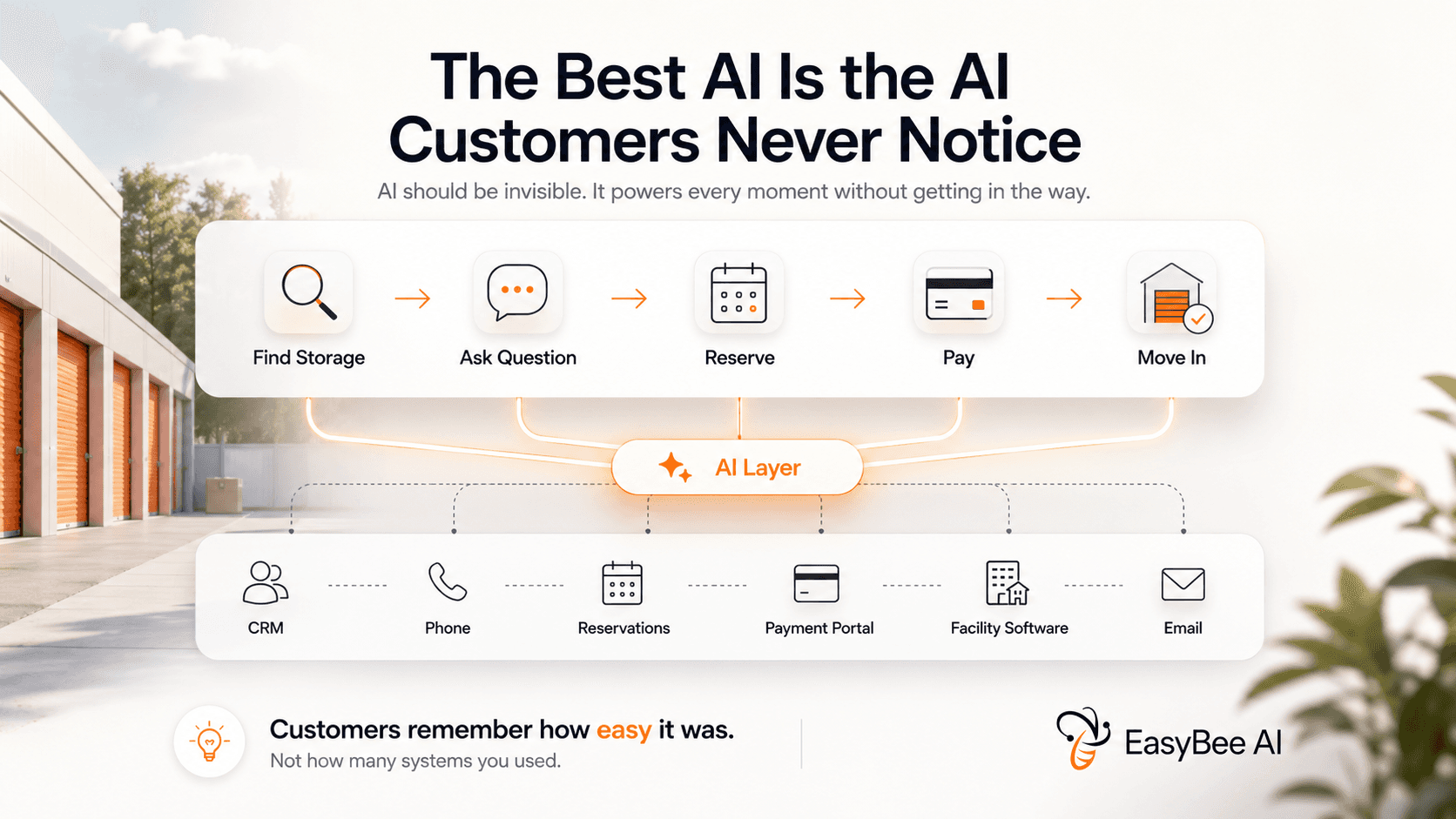
Technology should never become another obstacle between your customer and a storage unit.
-
Customers Don't Care About AI
Imagine someone searching for storage at 8:42 PM.
They're moving the next morning. The truck is booked. Boxes are stacked in the garage.
They need a 10×15 climate-controlled unit before sunrise.
They find your website, they call & NO ONE ANSWERS.
They submit a contact form, the confirmation says someone will reach out tomorrow.
Three minutes later,
They're reserving a unit somewhere else.
That customer didn't leave because your facility wasn't clean, they didn't leave because your prices were too high, they left because they couldn't get help when they needed it.
That's the real opportunity for AI.
Not replacing people.
Not adding another dashboard.
Not chasing the latest technology trend.
Simply making it easier for customers to get answers and complete the next step.
Customers don't wake up hoping to interact with AI.
They wake up needing storage.
If AI helps them accomplish that faster, they'll never think about the technology.
And that's exactly the point.
The Real Problem Isn't Marketing
When occupancy slows, it's easy to assume the problem is traffic.
More Google Ads.
More SEO.
More reviews.
More promotions.
Those things matter, but many facilities already generate enough demand. The challenge begins after someone decides to contact you.
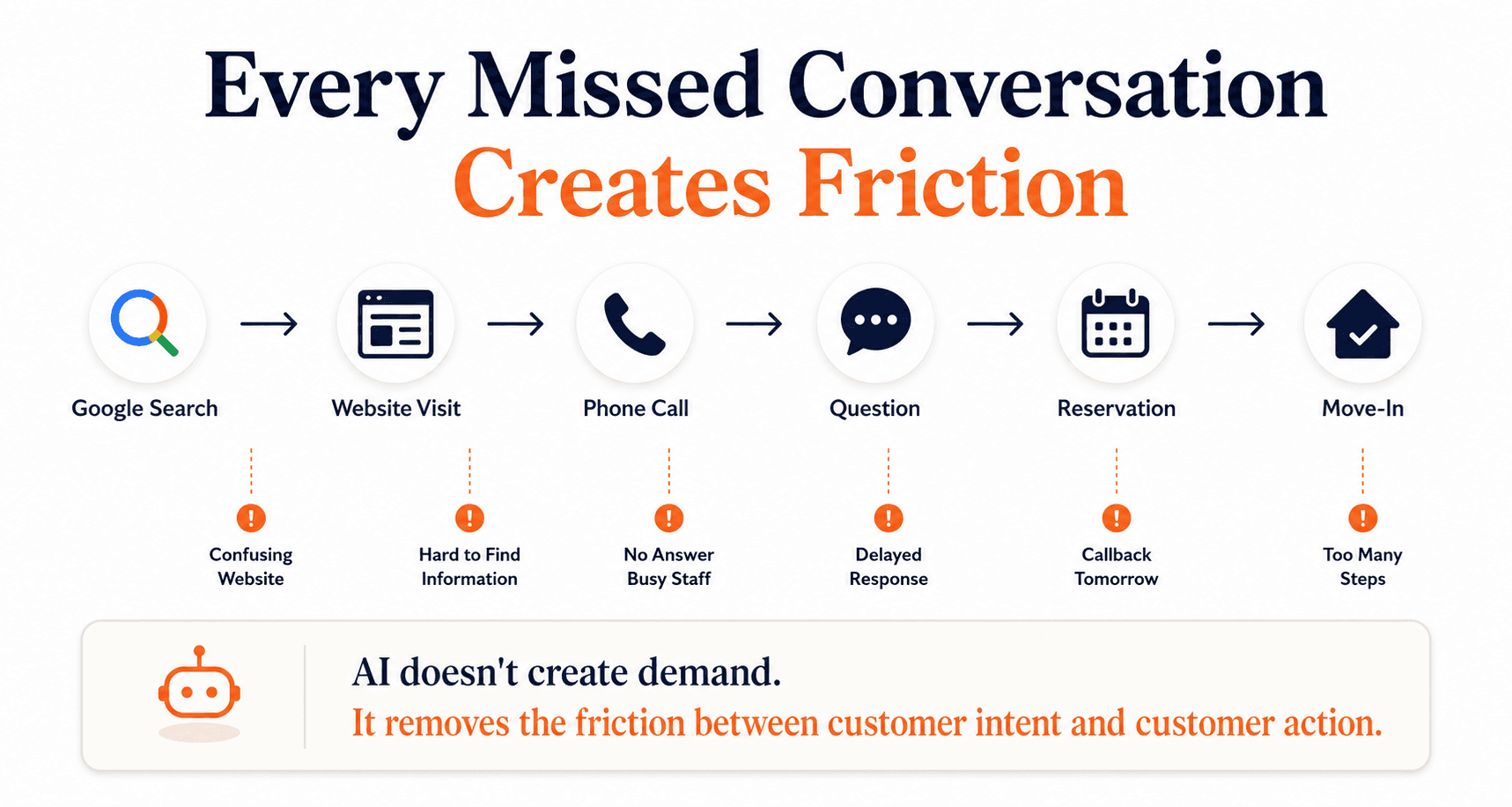
A missed phone call.
A delayed response.
A confusing website.
An unanswered question.
Each one creates friction. And friction quietly kills conversions.
The best operators aren't necessarily winning because they spend the most on marketing. They're winning because they make it easier for customers to move forward.
AI doesn't create demand.
It captures demand that's already there.
That's an important distinction.
What AI Actually Means in Self-Storage
Artificial intelligence has become one of the most misunderstood terms in business.
Some vendors call a chatbot 'AI'.
Others call reporting dashboards 'AI'.
Some simply add "AI-powered" to software that hasn't fundamentally changed.
For operators, the definition should be much simpler.
Ask one question:
Does this technology remove repetitive work while improving the customer experience?
If the answer is yes, it's worth exploring.
If the answer is no, it's probably just another feature.
In self-storage, modern AI generally supports four operational areas:
Capability | What it Does | Business Outcome |
|---|---|---|
Voice AI | Answers calls, qualifies prospects, books reservations | Captures after-hours demand |
Website AI | Answers questions and guides visitors | Improves website conversion |
Workflow Automation | Updates systems and triggers follow-ups | Saves staff time |
Knowledge AI | Retrieves policies and facility information | Delivers consistent answers |
Notice what's missing.
None of these replace the manager.
They remove repetitive work so your team can focus on the conversations that require experience, empathy, and judgment.
Where AI Creates the Most Value
Most discussions about AI begin with technology. Operators should start somewhere else.
Start with interruptions.
Ask any self-storage manager what consumes their day and you'll hear familiar answers.
The phone rings while they're helping another customer.
Someone wants to know what size unit they need.
A customer forgot their gate code.
Someone has a billing question.
Another wants to know if they can move in tonight.
None of those conversations are difficult.
Collectively, they consume hours every week.
That's where AI works best—not by doing extraordinary things, but by handling ordinary work exceptionally well.

Capture Every Inquiry
Every marketing dollar depends on one thing.
Someone answering the inquiry.
Many prospective tenants call after hours or while managers are already busy.
Those calls don't represent poor service.
They're simply the reality of running a busy facility.
The problem is that customers rarely distinguish between "they were busy" and "they never answered."
They simply call the next facility.
A good AI voice assistant ensures every inquiry receives an immediate response, whether someone calls at 10 AM or 10 PM.
Help Customers Make Decisions
One of the most common questions operators receive isn't about price.
It's about confidence.
Will a one-bedroom apartment fit?
Should I choose climate control?
Can I store business inventory?
These conversations follow familiar patterns.
AI can guide customers using the same recommendations your team already provides.
The goal isn't to replace advice.
It's to make good advice available whenever customers need it.
Reduce Repetitive Work
Not every phone call creates revenue.
Many simply consume time.
Office hours.
Gate access.
Payment options.
Insurance requirements.
Holiday schedules.
Directions.
None of these questions are unimportant.
They're just repetitive.
When your team answers the same questions dozens of times each week, they have less time for work that actually grows the business.
AI quietly removes those interruptions so managers can focus on customers—not routines.
Connect the Customer Journey
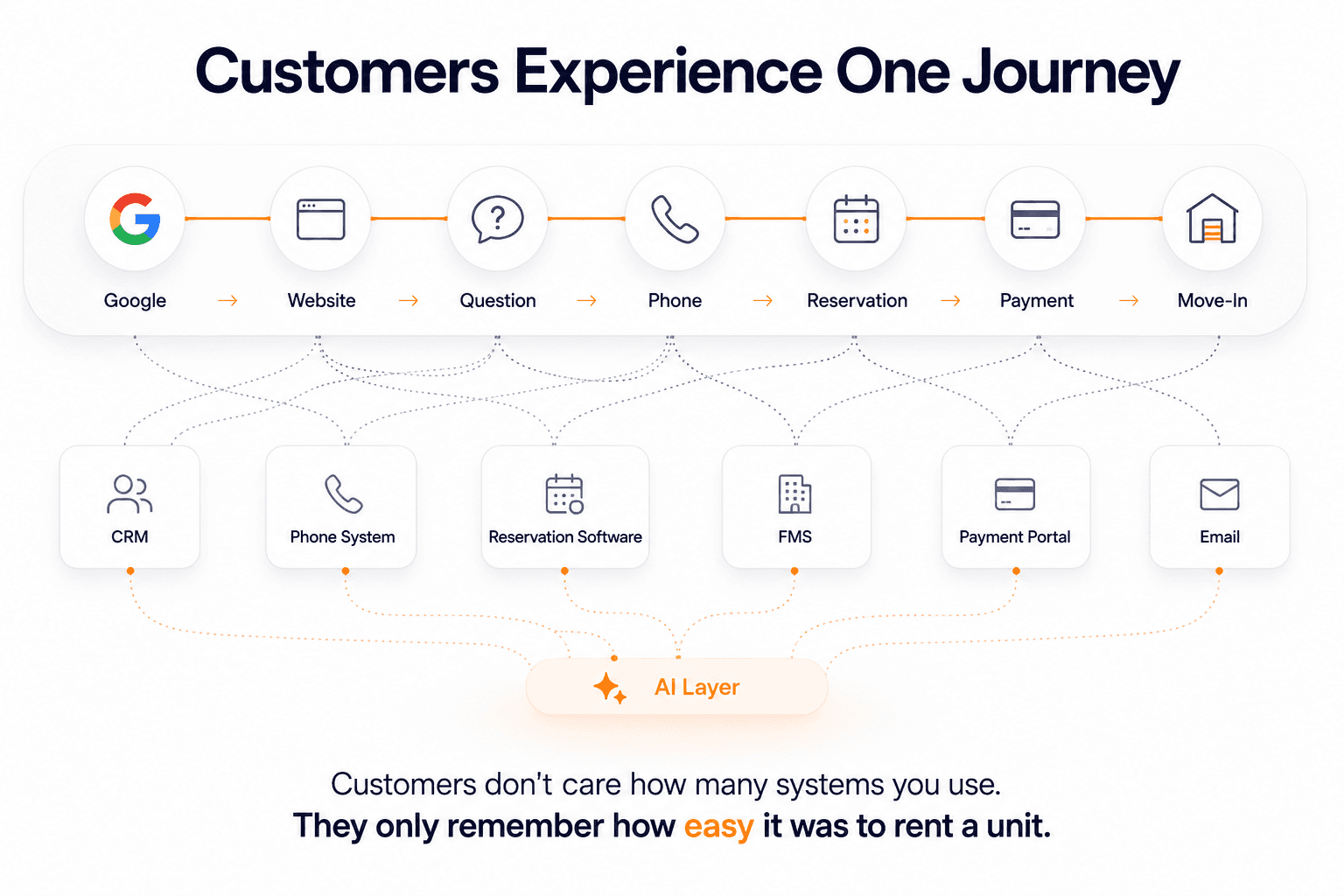
Customers don't think about software.
They think about outcomes.
They discover your facility through Google.
Visit your website.
Call with a question.
Reserve a unit.
Complete payment.
Move in.
To them, that's one journey.
Behind the scenes, it often involves multiple disconnected systems.
Good AI connects those systems so customers don't repeat information, staff don't manually transfer notes, and every interaction feels like part of one continuous conversation.
The technology fades into the background.
That's exactly where it belongs.

What Doesn't Work
Not every AI implementation succeeds.
The biggest mistake isn't choosing the wrong platform.
It's solving the wrong problem.
If your starting point is:
"Where can we add AI?"
You're already asking the wrong question.
Instead ask:
Where do customers wait?
Which questions consume the most staff time?
Where do prospective tenants abandon the rental process?
Which conversations truly require a person?
Technology should remove friction.
Not introduce another layer of complexity.
AI Works Best Alongside Great People
Some AI companies position automation as a replacement for staff.
We don't think that's the future.
The best operators still rely on people for the moments that matter.
Helping someone during a stressful move.
Resolving a billing dispute.
Handling a security issue.
Supporting a frustrated customer.
Those conversations deserve empathy and judgment.
AI shouldn't replace them.
It should protect your team's time so they can have more of them.
The best AI doesn't replace your best employee.
It helps them spend more time being their best employee.
Final Thoughts
For years, technology conversations in self-storage have focused on adding more.
More software.
More dashboards.
More features.
More integrations.
But customers don't experience your business that way.
They experience moments.
A phone call.
A reservation.
A payment.
A move-in.
If those moments feel effortless, customers rarely think about the technology behind them.
They simply remember that doing business with you was easy.
That's what good AI should enable.
Not more complexity.
Not another platform to manage.
Just faster answers.
Fewer interruptions.
Better experiences.
Because at the end of the day, the best AI isn't the one with the most impressive demo.
It's the one your customers never notice.
They just notice that everything worked.