AI Receptionist for Self-Storage: Features, Cost & Guide | EasyBee AI
Learn how an AI receptionist for self-storage answers calls, qualifies renters, supports bookings and works 24/7—plus costs and when it makes sense.
AI Receptionist for Self-Storage: What It Does, Costs and When It Makes Sense
The phone rings while your manager is helping someone at the counter.
Another call comes in while they’re walking the property.
Then another at 8:47 PM, long after the office has closed.
None of those callers know why you didn’t answer. They only know that they need storage—and someone else might pick up.
For years, operators had a few options: hire more staff, forward calls to a call center, let them go to voicemail, or accept that some inquiries would be missed.
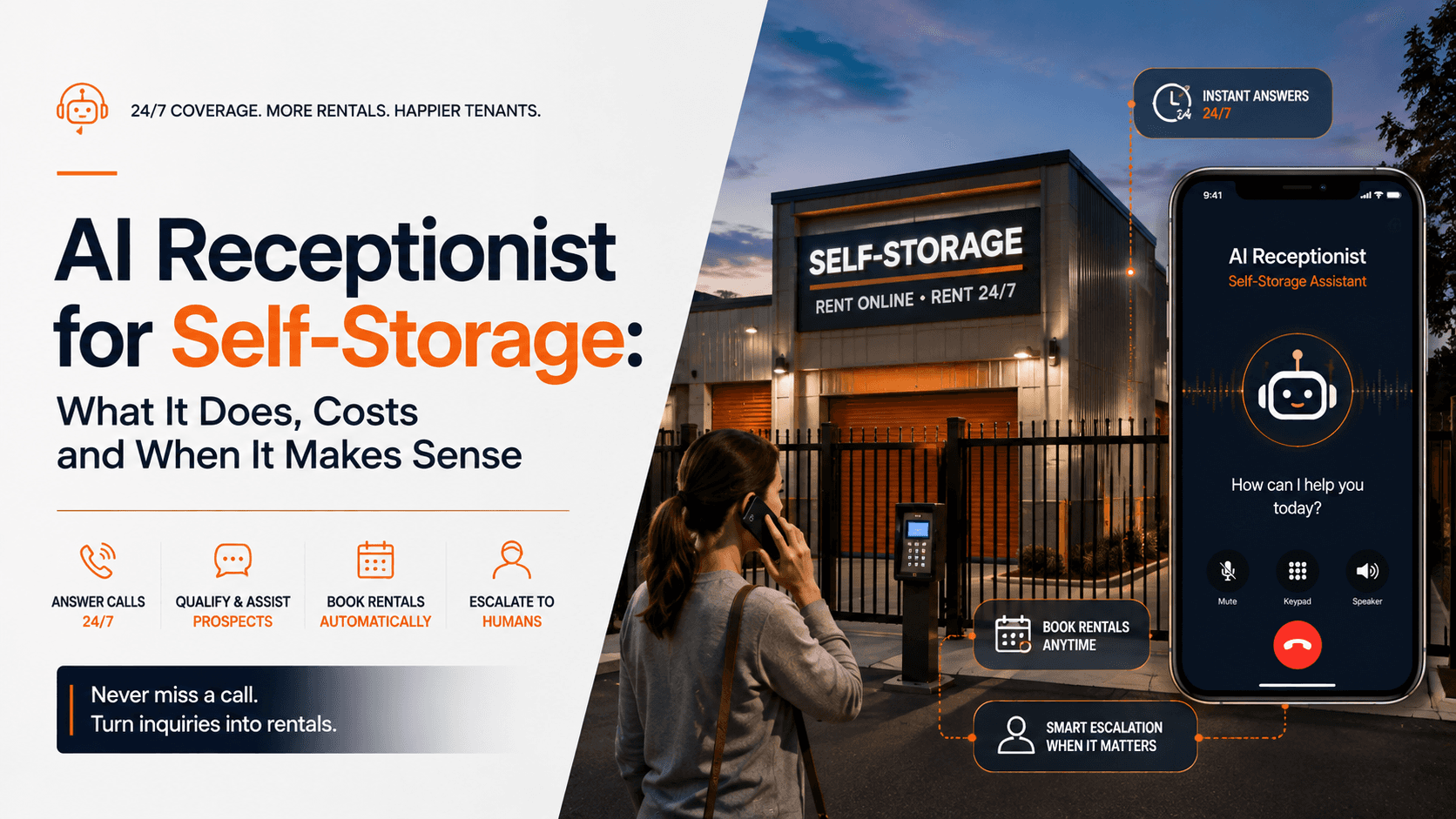
An AI receptionist for self-storage introduces another option: using AI for self-storage to answer customer calls, provide after-hours coverage, handle routine questions, and help prospective tenants move toward a rental.
Instead of simply taking a message, modern AI can answer the phone, have a conversation, understand what the customer needs, provide information, support the rental journey, and involve your team when the situation actually requires a person.
But what can an AI receptionist really handle?
How is it different from an answering service?
And perhaps most importantly: when does paying for one actually make sense?
What Is an AI Receptionist?
An AI receptionist is software that uses conversational AI to interact with customers through channels such as phone and web.
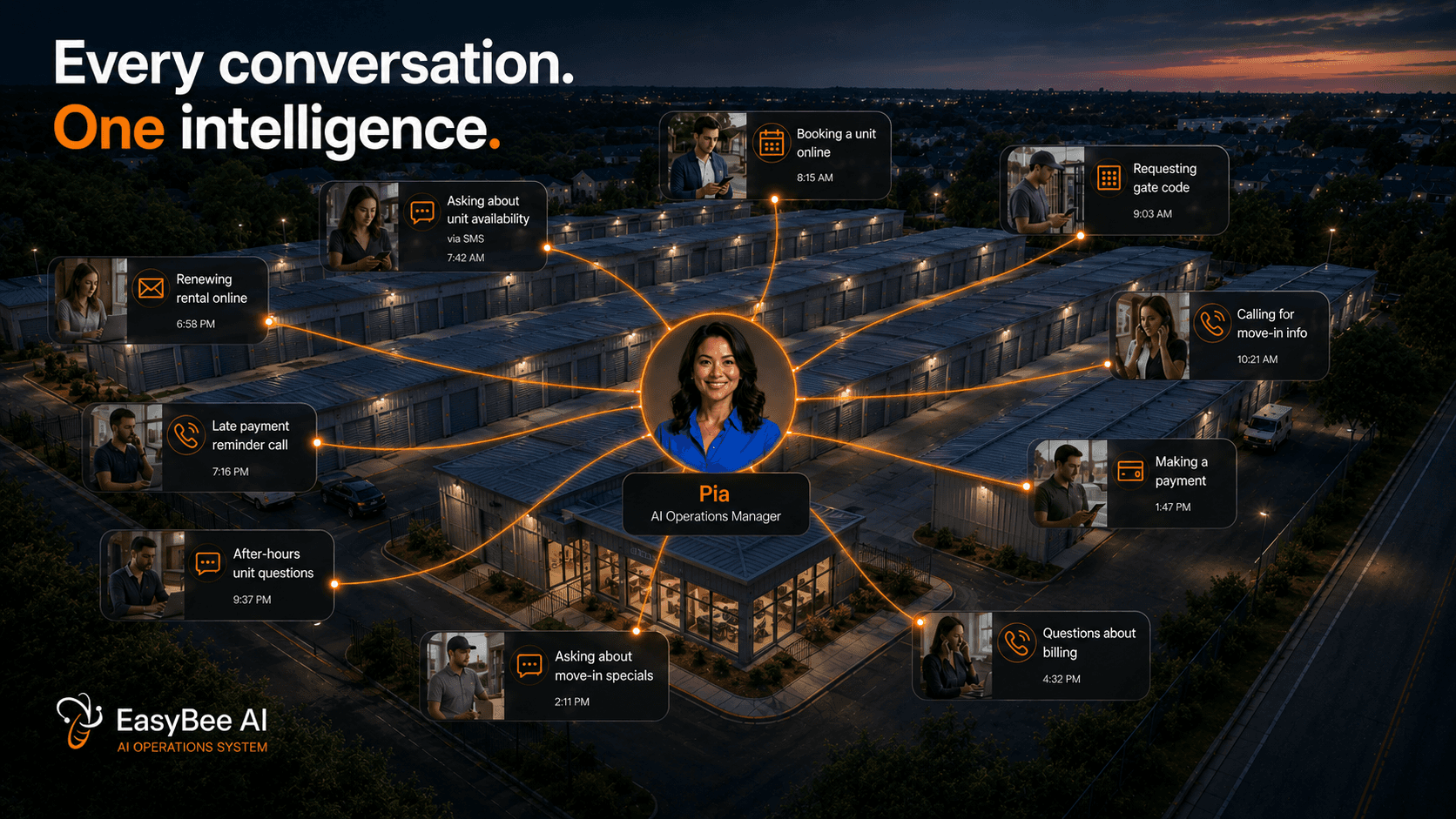
For self-storage operators, that can mean answering incoming calls when the manager is unavailable, responding after hours, handling repetitive questions, qualifying prospective tenants, and supporting parts of the rental journey.
Think of it less like voicemail and more like a first layer of customer service.
A traditional phone system might say:
“Press 1 for office hours. Press 2 for billing.”
An AI phone receptionist can instead understand a customer who says:
“I’m moving out of a two-bedroom apartment next week and need to know what size unit I should get.”
The interaction becomes conversational rather than menu-driven.
And because AI receptionist software isn’t tied to a person sitting behind a desk, the same first layer of service can remain available after the office closes or while staff are occupied elsewhere.
What Can an AI Receptionist Do for a Self-Storage Facility?
An AI receptionist shouldn’t be judged by how human it sounds.
It should be judged by how much useful work it can actually complete.
For a self-storage facility, that can include several common workflows.
Answer Calls 24/7
The most obvious use case is availability.
AI phone answering allows a facility to respond when staff are busy, after office hours, during call spikes, or across multiple locations.
An AI phone answering service can provide that coverage without requiring someone to remain beside the phone throughout the day.
That means a prospect calling at 9 PM doesn’t necessarily have to hear voicemail and wait until morning.
Answer Routine Questions
Storage managers answer many of the same questions every day:
What are your office hours?
When can I access my unit?
Do you offer climate-controlled storage?
What sizes are available?
How much does a unit cost?
What documents do I need?
How does move-in work?
Do you sell boxes or locks?
An AI virtual receptionist can handle many of these repetitive conversations while allowing staff to focus on customers who need direct assistance.
Qualify Prospective Renters
A useful receptionist doesn’t simply answer questions.
It helps move the conversation forward.
AI can ask what the customer is storing, when they need the unit, what size they may need, and other relevant questions before helping them take the next step.
That turns AI call answering from a defensive tool—“don’t miss the call”—into part of the leasing process.
Support Reservations and Rentals
Answering the call is only the beginning.
Depending on how the AI is configured and connected to the operator’s systems, it can help customers move toward a reservation or rental.
That might mean checking relevant information, answering questions about available units, helping the prospect choose an option, or guiding them toward the appropriate next step.
The important distinction is whether the system merely provides information or can actually take action inside the workflow.
Handle Existing-Tenant Questions
Not every call is a new lead.
Existing tenants call about payments, access, account questions, move-outs, and facility policies.
An AI receptionist can handle appropriate routine requests while sending unusual or sensitive situations to staff.
Escalate to a Person
This may be the most important capability.
Good AI shouldn’t try to win an argument with an angry tenant.
Nor should it improvise its way through an emergency or complicated billing dispute.
When human judgment is needed, the conversation should move to a person—with enough context that the customer doesn’t have to start over.
The goal isn’t to keep people away from your staff.
It’s to make sure your staff spend their time on the conversations where they’re actually needed.
AI Receptionist vs. Traditional Answering Service
An AI answering service and a traditional answering service can solve some of the same problems, but they operate differently.
Capability | Traditional Answering Service | AI Receptionist |
|---|---|---|
Answer calls after hours | Yes | Yes |
Handle multiple calls simultaneously | Staffing dependent | Yes |
Answer routine facility questions | Yes, depending on training/scripts | Yes, based on configuration |
Consistent responses | Can vary | Configurable |
Qualify prospective renters | Possible | Yes |
Support digital channels | Depends on provider | Can |
Integrate into workflows | Varies | Can |
Operate 24/7 | Usually available as an option | Yes |
Escalate to staff | Yes | Yes |
Handle complex human judgment | Yes | Should escalate |
Neither model is automatically better.
A traditional answering service can be valuable when calls frequently require nuanced human judgment.
An AI receptionist becomes particularly useful when much of the incoming volume is predictable, repetitive, and structured.
The question isn’t:
AI or humans?
It’s:
Which conversations actually require a human?
AI Receptionist vs. Voicemail
This comparison is much simpler.
Voicemail records demand.
An AI receptionist can respond to it.
If someone calls asking whether you have a 10×10 available tonight, voicemail asks them to leave their name and number.
An AI answering service can potentially answer the question immediately and help the caller continue.
That matters because storage can be a time-sensitive purchase.
Someone who needs a unit for an upcoming move isn’t necessarily waiting until tomorrow for a callback. They may simply call another facility.
The value of answering isn’t just customer service.
It’s maintaining the opportunity while the customer is still looking.
AI Receptionist Cost: What Does a Virtual Receptionist Cost?
There is no universal AI receptionist cost.
Pricing varies based on the provider, call volume, minutes or usage, channels, integrations, complexity of the workflows, implementation requirements, and level of support.
You’ll generally encounter models such as:
Monthly Subscription Pricing
A recurring platform fee, sometimes with a certain amount of usage included.
Usage-Based Pricing
Charges based on call minutes, conversations, or another consumption metric.
Subscription + Usage
A base monthly fee plus additional charges based on usage.
Custom or Facility-Based Pricing
Pricing based on the number of locations, workflows, integrations, or overall deployment scope.
This is why searching for virtual receptionist pricing can produce dramatically different numbers.
Two products called an “AI receptionist” may do very different things.
One might simply answer calls and take messages.
Another may connect with operational systems, qualify leads, support reservations, handle account questions, trigger follow-ups, and work across multiple customer channels.
So when comparing virtual receptionist cost, don’t compare the monthly fee alone.
Compare what the receptionist can actually replace, recover, or enable.
How to Think About AI Receptionist ROI
Start with the work happening today.
How many calls does your facility receive?
How many aren’t answered?
How many arrive after hours?
How much time does staff spend answering repetitive questions?
How many facilities need coverage?
How much would additional receptionist or call-center coverage cost?
And what happens when a prospective renter never receives an answer?
An AI receptionist doesn’t need to eliminate a full-time role to create value.
Suppose it simply removes several hours of repetitive calls each week while providing after-hours coverage.
That time can go back to:
Customers physically at the property
Facility operations
Collections and delinquency work
Sales follow-up
Property inspections
Complex tenant situations
There’s also the other side of the equation: opportunities that would otherwise have been missed.
If an unanswered call represents a prospective renter, the cost of missing that interaction isn’t simply the cost of returning a phone call.
It may be the value of the rental itself.
For operators, the economic question should therefore be:
What does it cost us to provide the same level of availability without it?
That’s often a more useful comparison than software price alone.
When Does an AI Receptionist Make Sense for Self-Storage?
AI tends to make the most sense when the communication problem is high-volume, repetitive, or happening when employees aren’t available.
You Miss Calls While Staff Are Busy
Managers can’t answer the phone while simultaneously helping someone at the counter, touring the property, inspecting units, or dealing with an operational issue.
AI can provide the first layer of coverage instead of forcing the caller to wait.
You Receive Meaningful After-Hours Demand
Customers don’t limit storage searches to office hours.
If prospects regularly call in the evening or on weekends, 24/7 coverage can extend the sales window without requiring someone to staff the office around the clock.
Your Team Answers the Same Questions Constantly
The more predictable the conversation, the stronger the automation opportunity.
Your manager doesn’t necessarily need to personally explain access hours for the hundredth time.
You Operate Multiple Facilities
As portfolios grow, customer communication becomes harder to scale consistently.
An AI virtual receptionist can provide a common first layer across locations while routing facility-specific or exceptional situations appropriately.
You Want More Than an Answering Service
If the objective is simply “someone needs to pick up,” a traditional answering service may solve the problem.
If the objective is to answer, qualify, assist, take action, and connect the conversation with other workflows, AI receptionist software becomes more interesting.
When Doesn’t an AI Receptionist Make Sense?
AI isn’t automatically the right answer for every facility.
If your call volume is extremely low and nearly every call reaches a manager immediately, the economic case may be weaker.
If most customer conversations require complex judgment, the amount that can be automated may be limited.
And if the AI isn’t connected to accurate facility information, policies, pricing, availability, or the workflows it needs to support, it can create more friction than it removes.
There’s another important consideration: escalation.
An AI receptionist that handles routine conversations well but fails when something unusual happens isn’t a complete customer-service solution.
Operators need to know where automation stops and where their team takes over.
The goal isn’t to install AI because everyone is talking about AI.
The goal is to identify where customer demand and staff availability don’t line up.
That’s the gap an AI receptionist should solve.
What to Look for in AI Receptionist Software
If you’re comparing the best AI receptionist options for a self-storage operation, don’t choose based on the demo voice alone.
A natural voice is useful.
But production capability matters much more.
Does It Understand Self-Storage?
Can it correctly handle questions about unit sizes, climate control, access, rentals, move-ins, payments, and facility policies?
A generic receptionist and an AI receptionist for self-storage aren’t necessarily the same thing.
Industry context matters.
Can It Take Action?
Can the system only answer questions?
Or can it support bookings, follow-ups, payments, reminders, and other workflows?
This is where AI begins moving from “answering software” to operational automation.
Does It Work With Your Existing Systems?
The receptionist shouldn’t become another isolated inbox your employees have to manage.
Look at how it connects with the systems and workflows your team already uses.
A useful AI layer should fit into the customer journey rather than forcing employees to create a separate process around it.
What Happens When AI Doesn’t Know the Answer?
This question matters more than almost any feature on the sales page.
Does it guess?
Take a message?
Transfer the caller?
Create a task?
Send the conversation to your team?
The answer should be clear before the system starts speaking with customers.
A reliable escalation process is fundamental.
Can It Handle More Than Phone Calls?
Customers don’t always stay in one channel.
Someone may discover your facility through search, ask a question on your website, call later, and eventually complete a rental online.
An AI platform capable of supporting voice and digital interactions can create a more connected customer journey than several isolated tools.
Can You Measure the Outcome?
Look beyond conversation counts.
Useful metrics might include:
Calls answered
Missed calls reduced
After-hours conversations
Qualified inquiries
Reservations supported
Staff time saved
Escalation rates
Customer outcomes
AI should create an operational result—not simply more analytics.
AI Receptionist, AI Phone Receptionist and Virtual Receptionist: What’s the Difference?
The terminology can become confusing because vendors use several labels for similar products.
An AI receptionist is the broad category: conversational software that acts as a first point of contact.
An AI phone receptionist or AI voice receptionist emphasizes phone conversations.
An AI answering service usually emphasizes answering inbound calls and providing coverage.
An AI virtual receptionist emphasizes remotely performing receptionist-type work through software.
A virtual receptionist isn’t necessarily AI. The term can also describe a human receptionist working remotely.
An automated receptionist is broader still and can include AI as well as traditional menu-driven or rules-based systems.
And AI front desk is sometimes used to describe similar technology, particularly when the system handles several customer-facing responsibilities rather than simply answering the phone.
For operators, the label matters less than the capability.
Ask what happens after the receptionist says hello.
From AI Call Answering to Self-Storage Automation
The biggest opportunity may not be answering more calls.
It’s connecting those conversations to the rest of the operation.
Consider a prospective tenant who calls after hours.
The AI answers.
The prospect explains what they’re storing.
The system helps them understand their options.
The customer decides they’re interested.
Now what?
If the conversation ends with “someone will call you tomorrow,” you’ve improved the answering experience but haven’t necessarily transformed the workflow.
The more useful model connects customer conversations with the actions that should follow them.
That’s where an AI receptionist begins to overlap with broader self-storage automation.
The receptionist becomes the front door.
Behind it can sit reservations, follow-ups, reminders, account workflows, escalation, and other operational processes.
That’s a much bigger opportunity than replacing voicemail.
The Best AI Receptionist Should Feel Less Like Software
Customers don’t call a storage facility because they want to experience AI.
They call because they need something.
A unit.
A price.
An answer.
Help getting through the gate.
Information about their account.
The best AI call answering experience therefore isn’t the one that constantly reminds customers they’re interacting with sophisticated technology.
It’s the one that gets them where they need to go with as little friction as possible.
And when the conversation needs a person, it gets out of the way.
That’s when an AI receptionist starts making sense—not as another tool for your staff to manage, but as another layer of availability around the business.
Frequently Asked Questions About AI Receptionists for Self-Storage
What is an AI receptionist for self-storage?
An AI receptionist for self-storage is conversational software configured to handle common customer and prospect interactions for storage facilities. It can answer calls, respond to routine questions, qualify renters, support rental workflows, and escalate appropriate conversations to employees.
Can an AI receptionist answer phone calls 24/7?
Yes. An AI phone receptionist can provide around-the-clock call coverage without requiring an employee to remain at the facility after hours. The specific capabilities available depend on the platform and how it is configured.
Can an AI receptionist book storage units?
Depending on the platform and its integrations, an AI receptionist can support or complete parts of the reservation and rental process. Operators should verify what actions a particular platform can perform rather than assuming every AI receptionist has the same capabilities.
How much does an AI receptionist cost?
AI receptionist pricing varies by provider and may depend on call volume, usage, locations, integrations, channels, and workflow complexity. Common models include monthly subscriptions, usage-based pricing, subscription-plus-usage, and custom pricing.
How much does a virtual receptionist cost?
Virtual receptionist cost depends heavily on whether the service uses human receptionists, AI, or a combination of both, as well as call volume and the work being performed. Operators should compare capabilities and coverage alongside price rather than comparing monthly fees alone.
Is an AI receptionist cheaper than an answering service?
It can be, particularly for repetitive or high-volume interactions, but price alone isn’t a useful comparison. Operators should compare coverage, capabilities, implementation, integrations, escalation, and the amount of staff work each option handles.
What is the difference between an AI receptionist and an AI answering service?
The terms overlap. An AI answering service generally emphasizes answering inbound calls, while an AI receptionist may perform a broader set of tasks such as qualifying leads, answering questions, supporting bookings, handling digital conversations, and triggering workflows.
Is an AI receptionist the same as a virtual receptionist?
Not necessarily. A virtual receptionist may be a human working remotely or an AI system. An AI virtual receptionist specifically uses conversational AI to perform receptionist-type tasks.
Can an AI receptionist replace a self-storage manager?
An AI receptionist shouldn’t be viewed as a complete replacement for a self-storage manager. AI is better suited to repetitive, high-frequency interactions, while employees remain important for situations involving judgment, empathy, physical facility work, disputes, emergencies, and unusual customer needs.
Answer Every Inquiry Without Adding Another Front Desk
EasyBee AI helps self-storage operators provide 24/7 customer coverage across voice and digital channels, automate repetitive conversations, support rental workflows, and escalate situations that need a person.