Self-Storage Phone Answering: Calls, After-Hours & AI | EasyBee AI
Learn how self-storage phone answering works, from call centers and answering services to AI. Compare after-hours coverage, automation and 24/7 support.

Self-Storage Phone Answering: How to Answer Every Call, Even After Hours
A prospective tenant calls while your manager is helping someone at the counter.
Another calls while they’re walking the property.
Someone else calls at 8:30 PM, after the office has closed.
The reason the call wasn’t answered is different every time.
To the customer, the experience is exactly the same:
Nobody answered.
That’s what makes self-storage phone answering an operational problem rather than simply a staffing problem.
Storage operators have traditionally solved it with additional staff, voicemail, phone trees, centralized call centers, or third-party answering services. Today, AI adds another option: calls can be answered and routine conversations handled automatically, including when nobody is sitting behind the front desk.
The right approach depends on what happens when your phone rings, what customers typically need, and how much of that conversation actually requires a person.
Why Self-Storage Calls Are Difficult to Cover
A storage manager isn’t a receptionist.
On any given day, they may be helping walk-in customers, inspecting the property, checking units, handling payments, dealing with maintenance, following up with tenants, or working through administrative tasks.
The phone doesn’t care.
It rings whenever the customer decides to call.
That creates a fundamental mismatch between customer availability and staff availability.
And many callers aren’t simply looking for your office hours.
They may want to know:
What units are available?
What size unit do I need?
How much does storage cost?
Do you have climate-controlled units?
Can I move in today?
What are the access hours?
How do I make a payment?
Why isn’t my gate code working?
Effective storage phone answering therefore needs to do more than pick up the call.
It needs to help the customer get somewhere.
What Is a Self-Storage Answering Service?
A storage answering service provides phone coverage when facility employees can’t answer incoming calls themselves.
Traditionally, that has meant calls being routed to an external human answering service or call center.
Depending on the provider and setup, the service may answer basic questions, take messages, qualify callers, transfer calls, or provide other customer support.
The basic objective is simple:
Don’t let staff availability determine whether the customer gets an answer.
For self-storage operators, this can be particularly useful during busy periods, lunch breaks, evenings, weekends, holidays, and across portfolios where one team supports multiple facilities.
But answering the call is only the first question.
The second is what the answering service can actually do once the customer is on the line.
Self-Storage Call Answering: What Should Happen After “Hello”?
Good self-storage call answering should be designed around customer intent rather than simply call volume.
Consider three different callers.
One asks:
“What time does the gate close?”
Another asks:
“I’m moving from a two-bedroom apartment. What size unit should I rent?”
A third says:
“My account was charged twice and I need someone to fix it.”
All three need an answer.
They don’t necessarily need the same kind of answer.
The first is a routine information request.
The second requires a useful conversation that could lead to a rental.
The third may require account access and human judgment.
A good phone strategy identifies which conversations can be handled immediately, which can be automated, and which should reach an employee.
That’s much more useful than treating every incoming call identically.
What Is After-Hours Call Answering for Self-Storage?
After-hours call answering provides customer coverage when the facility office is closed.
For self-storage, that matters because the customer’s search for a unit doesn’t necessarily happen between 9 AM and 5 PM.
Someone might search for storage after work.
A family may discuss an upcoming move in the evening.
A customer could experience an access problem outside office hours.
A prospective renter may call several facilities in the same sitting.
Without after-hours coverage, the experience often becomes:
Call → No answer → Voicemail → Wait for callback
The alternative is:
Call → Immediate response → Question answered → Next step
Not every after-hours conversation needs to result in a rental.
But every customer should have a clear path forward.
What Are the Options for Self-Storage Phone Answering?
There isn’t one universal solution.
Most operators use some combination of five approaches.
1. Facility Staff
The simplest model is having the property manager or another employee answer calls.
The advantage is obvious: the employee understands the facility and can use human judgment.
The limitation is equally obvious.
One person can’t simultaneously answer every phone call and perform every other responsibility at the property.
2. Voicemail
Voicemail is inexpensive and easy.
But voicemail doesn’t answer the customer’s question.
It records the fact that the question existed.
That can work for low-priority inquiries, but it’s less useful when a prospect is actively comparing facilities.
3. Self-Storage Phone Tree
A self-storage phone tree uses menu options to route customers toward information or departments.
You’ve heard the model:
“Press 1 for rentals. Press 2 for billing. Press 3 for office hours.”
Phone trees can efficiently route structured requests, but customers still have to navigate predefined menus.
They also struggle when the customer’s question doesn’t fit neatly into one of the available options.
4. Self-Storage Call Center
A self-storage call center uses centralized representatives to answer customer calls for one or multiple facilities.
Call centers can provide broad coverage and human support without requiring every property to maintain dedicated phone staff.
For operators with several locations, centralization can also create more consistent phone coverage across the portfolio.
The trade-off is that coverage depends on staffing, training, scripts, service levels, and the information available to the call-center representative.
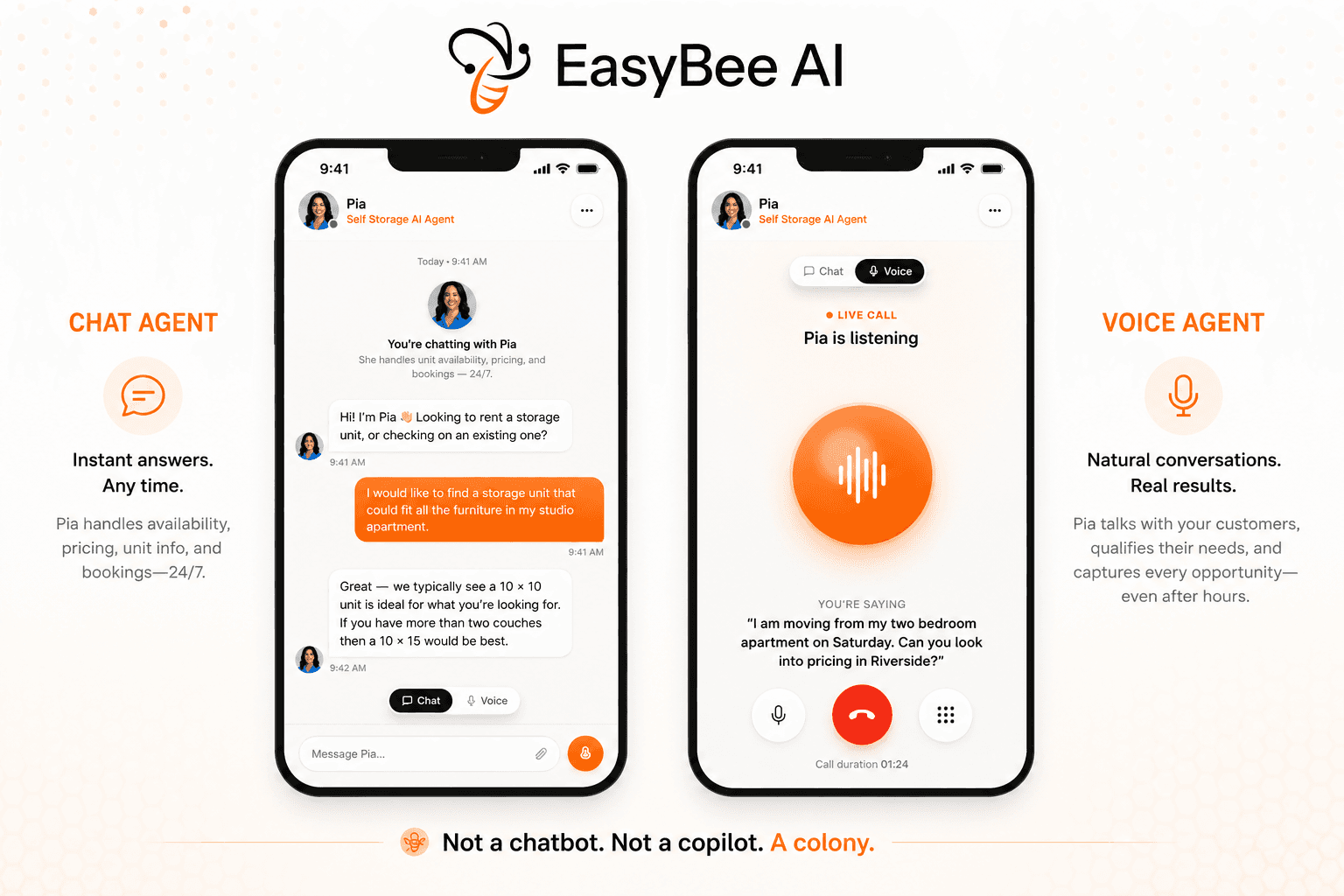
5. Automated or AI Call Answering
An automated storage call center or AI-based answering system uses conversational technology to handle some or all incoming conversations.
Unlike a traditional phone tree, modern conversational AI doesn’t necessarily require the customer to choose from predefined menu options.
The customer can simply explain what they need.
The AI can then understand the request, provide appropriate information, ask follow-up questions, support routine workflows, or escalate the conversation when a person is required.
Self-Storage Call Center vs. Answering Service vs. AI
These approaches overlap, but they aren’t identical.
Capability | Voicemail / Phone Tree | Human Answering Service / Call Center | AI Call Answering |
|---|---|---|---|
Answer outside office hours | Limited | Yes | Yes |
Have a natural conversation | No | Yes | Yes |
Answer routine questions | Limited | Yes | Yes |
Handle simultaneous calls | System dependent | Staffing dependent | Yes |
Qualify prospective renters | No | Yes | Yes |
Support rental conversations | Limited | Yes, depending on setup | Yes, depending on setup |
Handle complex judgment | No | Yes | Should escalate |
Consistency across locations | High but rigid | Training dependent | Configurable |
Requires human staffing per conversation | No | Yes | No |
Escalate unusual situations | Limited | Yes | Yes |
The right choice depends on the operation.
If almost every call requires human judgment, a human self-storage call center may be valuable.
If the majority of calls are predictable—availability, pricing, unit questions, access information, rentals, payments, or other routine requests—automation becomes more compelling.
And many operators don’t have to choose one model exclusively.
AI can handle the first layer while people handle exceptions.
What Is a Self-Storage AI Call Center?
A self-storage AI call center uses conversational AI to answer and manage customer calls rather than requiring a human representative for every interaction.
The important word is conversational.
Traditional automation expects the customer to adapt to the system:
“Press 1 for rentals.”
Conversational AI attempts to adapt to the customer:
“I’m moving next Friday and I’m not sure whether I need a 5×10 or 10×10.”
The system can understand what the caller is trying to accomplish and continue the conversation from there.
For a self-storage operator, an AI call center can potentially support:
New rental inquiries
Unit availability questions
Unit-size questions
Pricing and facility information
Access and office hours
Routine payment questions
Rental assistance
Lead qualification
After-hours calls
Follow-ups
Call routing and escalation
The objective isn’t to make every customer conversation automated.
It’s to stop requiring a human for every customer conversation.
How Does an Automated Storage Call Center Work?
An automated storage call center generally sits between the incoming customer and the operational systems or employees who can resolve the request.
A simplified interaction might look like this:
1. Customer calls
The system answers immediately rather than sending the caller to voicemail.
2. Customer explains what they need
They speak naturally rather than navigating a rigid menu.
3. AI identifies the intent
Is this a rental inquiry? An access question? A payment issue? Something else?
4. The system responds or takes an appropriate action
Routine questions can be handled immediately. Depending on the platform and integrations, the system may also support workflows such as rentals, payments, follow-ups, or updating connected systems.
5. Exceptions are escalated
Situations requiring judgment or direct employee involvement are routed appropriately.
That’s what separates conversational automation from a traditional phone tree.
The goal isn’t simply to automate the greeting.
It’s to automate the routine work behind the call.
AI Call Answering vs. a Self-Storage Phone Tree
The self-storage phone tree solved an important problem: routing calls without requiring someone to answer every one manually.
But it also created a familiar customer experience.
“Press 1…”
“Press 2…”
“Press 4…”
“Please listen carefully because our menu options have changed.”
Phone trees work when customer needs fit predictable categories.
Conversational AI changes the interface.
Instead of asking customers to understand your routing system, you allow them to describe their problem naturally.
The difference is:
Phone tree: Customer identifies the correct workflow.
Conversational AI: System identifies the customer’s intent.
That’s particularly useful in storage because customers don’t always know the industry’s terminology.
They may not know which unit size they need.
They may not know whether they need climate control.
They just know what they’re storing and what problem they’re trying to solve.
Can AI Turn Storage Calls Into Rentals?
It can help—but simply answering more calls doesn’t guarantee more rentals.
A successful rental conversation still needs to help the prospect make a decision.
That might mean understanding:
What they’re storing
How much space they need
When they need the unit
Which units are available
What the facility offers
What the next step is
This is where phone answering becomes more than customer service.
A prospective renter calling after hours is a live sales opportunity.
If the system can answer their questions and help them continue toward a reservation or rental, the call doesn’t have to wait until the office reopens.
The important distinction is between:
answering the phone
and
advancing the customer journey.
Operators evaluating phone solutions should ask about both.
When Does a Storage Answering Service Make Sense?
A storage answering service can make sense when the core problem is coverage.
For example:
You regularly miss calls.
Employees are busy with customers or property work and can’t consistently answer.
You need after-hours coverage.
Customers and prospects call outside normal office hours.
You operate multiple locations.
Centralized answering can reduce the need for every facility to handle every interaction independently.
Your managers spend too much time on repetitive calls.
Routine phone questions consume time that could be spent elsewhere.
Your call volume changes throughout the day.
Coverage becomes particularly valuable when several callers need help at once.
The bigger the gap between customer demand and employee availability, the stronger the case for an answering layer.
When Does AI Call Answering Make More Sense?
AI becomes particularly interesting when the calls you’re trying to cover are not only frequent but repeatable.
If your team hears the same questions every day, those conversations are candidates for automation.
If prospects call after hours with predictable rental questions, AI can provide immediate assistance.
If several facilities need consistent first-line coverage, one AI layer can potentially support those interactions across the portfolio.
And if the phone conversation needs to connect with other workflows, AI may offer more value than simply taking a message.
That’s when the question moves from:
“Who can answer our phones?”
to:
“How much of this conversation actually needs a person?”
What Should Never Be Left to Call Automation Alone?
Not every conversation belongs in an automated workflow.
Operators should define escalation rules for situations such as:
Emergencies
Security incidents
Complex billing disputes
Auctions or liens
Property damage
Highly unusual account issues
Angry or distressed customers
Situations where the system lacks reliable information
A good automated system knows what it can handle.
A better one also knows what it shouldn’t handle.
The objective isn’t maximum automation.
It’s reliable coverage with appropriate escalation.
How to Choose a Self-Storage Call Answering Solution
Don’t evaluate providers based only on whether someone—or something—answers the phone.
Start with what happens next.
Can It Answer the Questions Your Customers Actually Ask?
Generic call coverage is less useful if every meaningful question still has to be transferred back to the facility.
Can It Support Rental Conversations?
If a large percentage of calls come from prospective tenants, understand whether the solution can qualify callers and help move them toward a reservation or rental.
Does It Provide After-Hours Call Answering?
Don’t assume 24/7 coverage.
Understand exactly when the service operates and what it can accomplish outside your office hours.
Can It Work Across Multiple Facilities?
Multi-location operators should understand how facility-specific information, routing, reporting, and workflows are managed.
Does It Connect With Your Existing Operation?
Phone conversations shouldn’t become another isolated stream of information employees have to manually reconcile.
How Does Human Escalation Work?
Ask what happens when the caller needs something the system can’t or shouldn’t handle.
Can You Measure the Results?
Useful metrics may include calls answered, calls handled after hours, missed calls, qualified leads, rental outcomes, escalations, conversation topics, and staff time saved.
The best solution isn’t necessarily the one answering the most calls.
It’s the one producing the best operational and customer outcomes.
From Phone Answering to Self-Storage Automation
There’s a bigger opportunity hiding behind the phone.
Imagine a prospective renter calls at 9 PM.
The call gets answered.
Their questions are resolved.
They receive help choosing a unit.
They move toward a reservation.
Relevant information is captured.
And the appropriate follow-up happens without a manager remembering to do it the next morning.
Now you’re no longer talking about an answering service.
You’re talking about self-storage automation.
The phone becomes one entry point into a larger customer journey connecting conversations, rentals, follow-ups, payments, and operational workflows.
That’s where modern call answering becomes more interesting.
The goal isn’t just to answer every call.
It’s to make sure every call has somewhere useful to go.
The Best Phone Answering Experience Is the One That Resolves the Customer’s Need
Customers don’t care whether their call is handled by the property manager, a self-storage call center, a storage answering service, or AI.
They care about what happens after someone answers.
Can I get the unit?
Can I access the property?
Can I make the payment?
Can somebody help me?
For operators, that’s the standard worth optimizing around.
Because the real problem isn’t that a phone rang and nobody picked it up.
It’s that a customer needed something from your business—and couldn’t get it.
Frequently Asked Questions About Self-Storage Phone Answering
What is self-storage phone answering?
Self-storage phone answering refers to systems or services used to answer customer and prospect calls when facility staff aren’t available. Coverage can be provided by employees, call centers, answering services, automated systems, or conversational AI.
What is a self-storage call center?
A self-storage call center is a centralized operation that handles phone calls for one or more storage facilities. Depending on the service, representatives may answer questions, qualify prospective renters, support customer service, route calls, and assist with rental-related conversations.
What is a storage answering service?
A storage answering service provides call coverage for a storage business when facility employees can’t answer directly. Services may provide daytime overflow coverage, after-hours answering, message taking, customer support, or other call-handling functions.
What is after-hours call answering?
After-hours call answering allows customers to receive a response when the facility office is closed. It can be provided through a human answering service, call center, or automated AI system.
What is a self-storage phone tree?
A self-storage phone tree is an automated menu system that asks callers to select predefined options, such as rentals, billing, or office information. Unlike conversational AI, traditional phone trees generally require callers to navigate predetermined menus.
What is a self-storage AI call center?
A self-storage AI call center uses conversational AI to answer incoming calls, understand customer requests, respond to routine questions, support workflows, and escalate appropriate conversations to employees.
What is an automated storage call center?
An automated storage call center uses technology to handle some or all routine phone interactions without requiring a human representative for every call. Modern systems may use conversational AI rather than traditional menu-based automation.
Can AI answer self-storage calls after hours?
Yes. AI can provide after-hours call answering for routine inquiries and customer workflows when facility employees aren’t available. Operators should configure clear escalation paths for situations that require human judgment.
Can an answering service help increase storage rentals?
An answering service can help preserve rental opportunities by responding when facility employees can’t. Whether that translates into additional rentals depends on how effectively the service answers questions, qualifies prospects, and helps callers take the next step.
Answer More Calls. Give Your Managers Fewer Repetitive Ones.
EasyBee AI helps self-storage operators provide 24/7 voice coverage, handle routine customer conversations, support prospective renters, and escalate situations that need a person.