AI Call Center for Self Storage: The Complete Guide (2026)
40% of self-storage calls go unanswered. Discover how AI call centers help operators capture every lead, reduce staffing costs, and grow revenue 24/7 — without hiring more staff. AI call center self storage, self storage call center AI, AI phone agent self storage, self storage AI answering service, AI voice agent self storage.
Why Every Self-Storage Operator Needs an AI Call Center in 2026
There is a revenue leak hiding in plain sight at most self-storage facilities. It does not show up on your P&L. It does not appear in your occupancy report. It sits quietly in your missed calls log — every prospect who dialed, heard a voicemail, and rented from the facility down the street instead.
Industry data puts the number at 40% of all inbound calls going unanswered at the average self-storage facility. For a 300-unit property running at standard rental rates, that translates to roughly $58,000 in lost annual revenue — one missed call at a time, invisibly, every single day.
The fix is not hiring a night receptionist. The fix is an AI call center built specifically for how self-storage works.
What Is an AI Call Center for Self Storage?
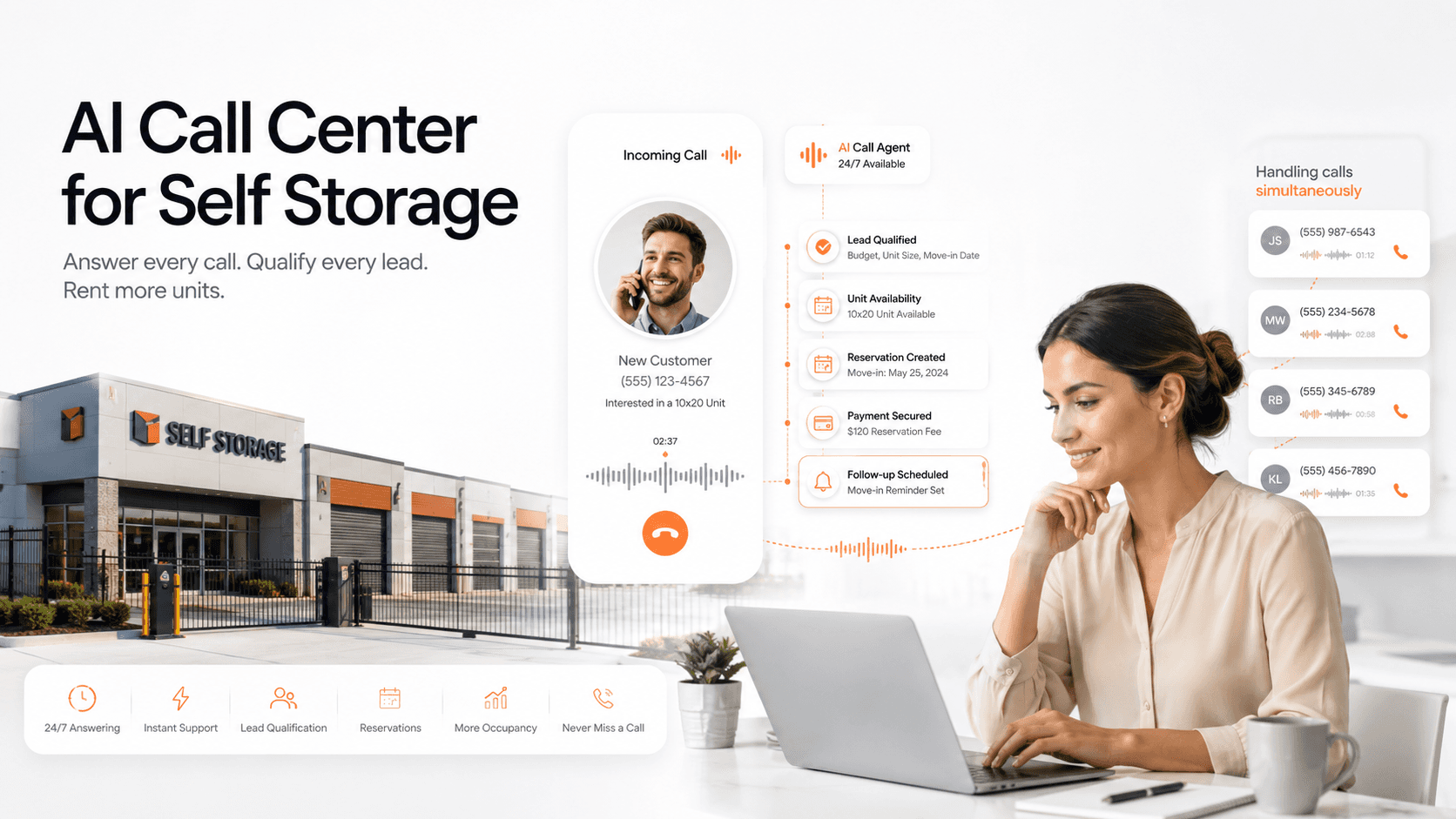
An AI call center for self storage is not a glorified voicemail system, and it is not a generic chatbot repurposed for the industry. It is a purpose-built AI voice and chat agent that answers every inbound call instantly, understands the specific language of self-storage operations, integrates directly with your facility management system (FMS), and handles the full customer journey — from unit sizing to payment — without requiring a human on the other end.
The best implementations handle:
New prospect inquiries — unit sizing recommendations, real-time pricing and availability, promotions, and reservation completion
Existing tenant requests — gate code lookups (with identity verification), balance inquiries, payment processing, and move-out scheduling
After-hours coverage — full-capability service at 10 PM on a Sunday, identical to what a human agent would deliver during business hours
Outbound collections — automated calls to delinquent tenants that recover payments without consuming staff time
Intelligent escalation — handing complex or emotionally charged conversations to a human agent, with full context transfer so the tenant never has to repeat themselves
The critical distinction from a generic phone system: a self-storage AI call center reads live data from your FMS on every call. It knows what units are available right now, what they cost today, and what your tenant's account balance is. Every answer it gives is accurate, current, and specific to your facility.
The Scale of the Problem: Why Calls Go Unanswered
Self-storage is, at its core, a call-dependent business. A prospective tenant identifies a need — a move, a downsizing, a business needing overflow storage — searches Google, finds two or three facilities nearby, and calls the first one. The whole decision typically happens within five minutes. If your phone goes to voicemail, they are already dialing your competitor.
The problem is structural. Most self-storage facilities are run by small teams — often one or two people managing the front desk, processing move-ins, handling gate issues, and fielding calls simultaneously. During busy periods, calls stack up. Before 9 AM and after 6 PM, nobody is there at all.
The numbers tell the story clearly:
40% of calls go unanswered, particularly after hours — and after-hours is when a significant share of prospects are searching and calling
70% of inquiries happen outside standard business hours, according to operator data compiled from EasyBee AI's live deployments
55% of storage renters book with the first facility they successfully contact, per the 2025 SSA Demand Study — meaning if your competitor answers and you do not, the rental is theirs
The average self-storage tenant stays 18–19 months, which means a single missed first call is not just a lost rental — it is nearly two years of monthly revenue that never materialized
For a facility charging $119/month for a standard 10'×10' unit (the 2026 industry average), losing even five rentals per month to unanswered calls represents more than $12,000 in annualized revenue loss — and that is before accounting for the upsell potential of climate-controlled units, insurance, or longer-term leases.
How an AI Call Center Actually Works — Step by Step
Understanding the mechanism helps operators evaluate what to look for when assessing AI platforms. Here is how a properly implemented AI call center handles a call from a new prospect:
1. Instant answer, every time. The phone rings once. The AI agent answers immediately — no hold music, no "your call is important to us," no voicemail. The caller hears a professional, natural-sounding voice ready to help.
2. Natural language understanding. The prospect says something like: "Hi, I'm moving out of a two-bedroom apartment next month and I need to figure out what size unit I need." The AI understands this in natural language — no menus, no "press 1 for reservations." It asks clarifying questions, establishes the scope of the move, and recommends the right unit size with confidence.
3. Live FMS data pull. Before quoting availability or pricing, the AI queries your facility management system in real time. It quotes the actual unit available at the actual current price — not a static figure from last month's rate card.
4. Reservation completion. The prospect says they want to book. The AI walks them through the reservation, collects the necessary information, and writes the reservation back to your FMS. The unit is off the market. The tenant gets a confirmation.
5. Context handoff if needed. If the conversation becomes complex — a nuanced lease question, a frustrated long-term tenant, an unusual situation the AI flags as escalation-worthy — it transfers to a human agent with a full summary of the conversation already provided. The tenant does not need to repeat a word, the escalation report does it all.
6. Logging and insight. Every call is logged, transcribed, and analysed. Operators gain visibility into call volumes, common questions, peak inquiry times, and conversion rates across their portfolio — data that was previously invisible.
The ROI Case: What Operators Are Actually Seeing
Abstract ROI projections are easy to produce. What matters is what operators with live AI call center deployments are actually reporting.
Across documented case studies from operators using AI voice and chat agents in self storage in 2025–2026:
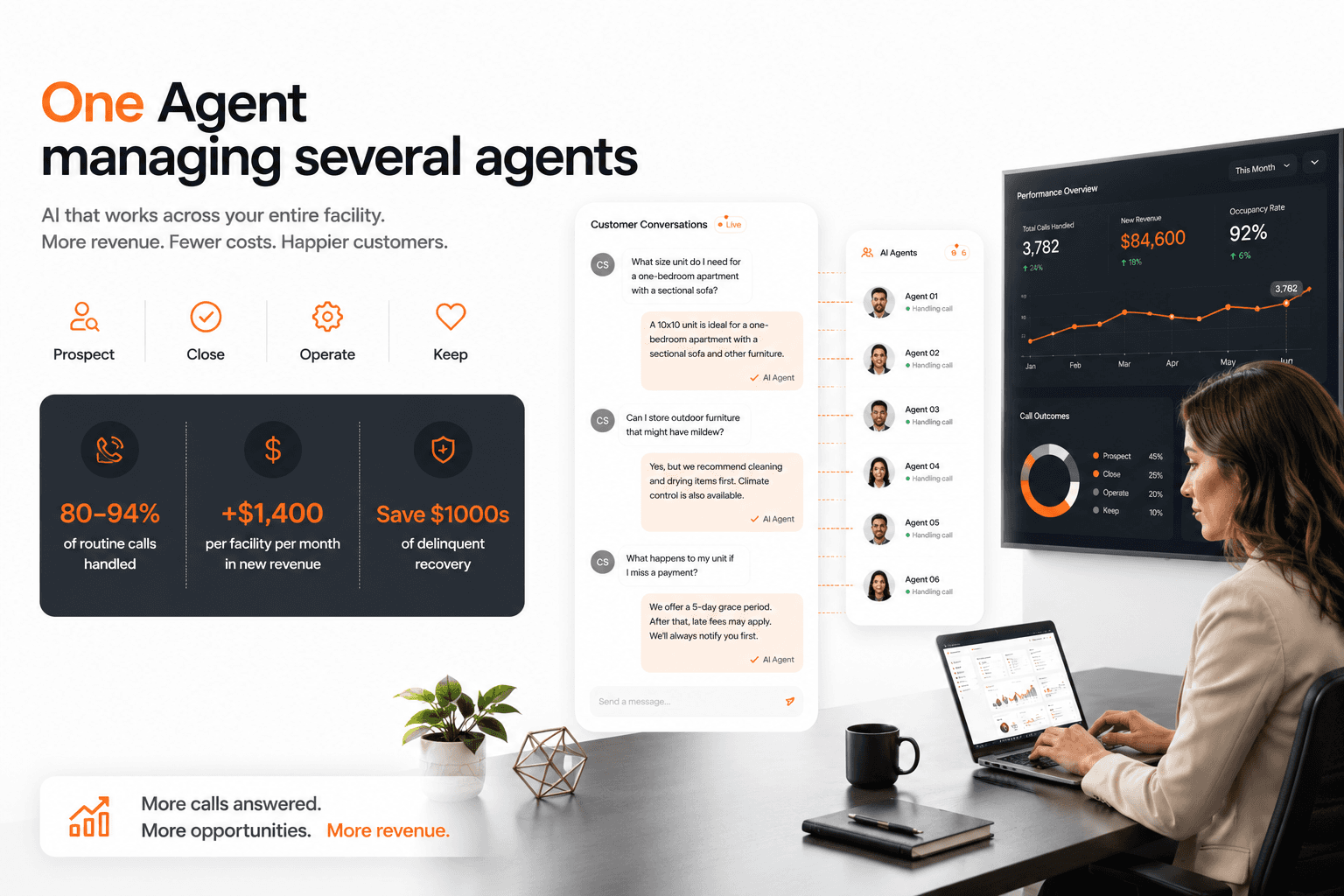
80–94% of routine calls handled without human involvement — the range reflects differences in deployment maturity and use-case scope, but even the lower bound represents a transformational reduction in call center workload
68% of all inbound calls handled by AI at an 11-facility Indiana operator running a two-person team across the entire portfolio — the human team focuses exclusively on high-value interactions
~$1,400 per facility per month in new recurring revenue captured from leads that would previously have gone to voicemail, at a 20+ facility California operator
90%+ call deflection across a 70+ facility RV and boat storage portfolio, with SiteLink integration reading live availability, pricing, and gate codes
One operator recovered over $4,000 in delinquent payments in a single day via automated AI outbound calls — with zero staff time consumed
25% reduction in call center staff costs reported by operators who have fully deployed AI, per industry benchmarks
The pattern is consistent: facilities that answer every call capture more rentals, run leaner operations, and generate data about their customer interactions that they previously had no access to.
What Makes a Self-Storage AI Call Center Different From Generic AI
This distinction matters, and operators who have attempted to deploy generic AI tools on their phone lines understand why. Self-storage has specific, non-negotiable operational requirements that a general-purpose AI cannot meet without purpose-built training:
FMS integration is non-negotiable. A call center AI that cannot read live data from SiteLink, storEDGE, SSM, or other facility management systems cannot give accurate answers. Quoting yesterday's pricing or a unit that was rented this morning is worse than not answering — it creates a negative experience that damages your reputation and wastes the prospect's time.
Storage-specific language and scenarios. The questions self-storage customers ask are highly specific: "What size unit do I need for a one-bedroom apartment with a sectional sofa?", "Can I store outdoor furniture that might have mildew?", "What happens to my unit if I miss a payment?" A purpose-trained AI handles these with the same fluency as an experienced storage manager. A generic AI system that has not been trained on thousands of storage-specific interactions will hallucinate answers or fail to understand the question.
Identity verification on sensitive requests. Gate codes are security-critical information. A storage AI must verify caller identity before releasing gate codes or account information — using name, account number, or the last digits of a phone number — to maintain the security standards your tenants trust you to uphold.
2FA and PCI compliance on payments. Payment processing over the phone has compliance requirements. A purpose-built storage AI handles payments via secure text links rather than collecting card numbers verbally, maintaining PCI compliance while still completing the transaction in the same call.
Emergency handling. Self-storage facilities occasionally receive calls involving genuine emergencies — break-ins, fires, medical situations on property. The AI must recognize emergency intent and respond appropriately, including routing to emergency services or the operator's on-call contact immediately.
Choosing an AI Call Center Platform for Self Storage: What to Evaluate
The market for self-storage AI has matured rapidly. As of 2026, there are several purpose-built platforms serving the industry, each with different strengths in voice quality, FMS integration depth, and call handling capabilities. When evaluating platforms, operators should assess:
FMS integration depth. Does the platform have native, bidirectional integration with your specific FMS — meaning it can both read and write data? Read-only integration limits functionality significantly. Ask specifically which version of the integration is supported and whether it covers payments, reservations, and gate code lookups.
Voice quality and naturalness. Tenants who feel they are talking to a robotic system abandon the call. Ask for a live demo with a test call to a deployed facility. Evaluate latency (the pause before the AI responds — target under 1.5 seconds), natural language fluency, and the persona's ability to handle interruptions and topic changes.
Automation rate benchmarks. What percentage of calls does the platform actually resolve without human involvement, across its deployed customer base? Ask for this figure specifically and ask how it is calculated. Swivel-point marketing claims are easy to make; ask for data from operators similar in size and complexity to your own portfolio.
Escalation quality. When a call does need to go to a human, how does the transfer happen? Does the human agent receive a transcript and summary, or does the tenant have to start over? Context handoff quality is often where the customer experience is won or lost.
After-hours capability. Can the AI handle the full range of tenant and prospect interactions at 2 AM on a Saturday, or does it fall back to a message-taking mode outside business hours? Full-capability after-hours service is one of the primary value drivers.
Reporting and analytics. What visibility does the platform provide into call volumes, call outcomes, common inquiry types, and conversion rates? The data generated by your AI call center should be a business intelligence asset, not just an operational record.
Getting Started: What Implementation Looks Like
For most self-storage operators, the path from decision to live deployment is shorter than expected. A purpose-built platform with established FMS integrations can be deployed in two to four weeks. The process typically involves:
FMS connection and data configuration — connecting the AI to your facility management system so it has access to real-time unit, pricing, and tenant data
Facility-specific customization — setting your specific policies, pricing structures, promotional offers, and escalation rules
Voice persona setup — selecting or configuring the AI's voice, name, and conversational style to match your brand
Testing and QA — running through standardized call scenarios (new prospect, gate code request, payment, escalation trigger) before going live
Staff briefing — ensuring your team understands what the AI handles, how escalations arrive, and how to read the call logs and analytics
After go-live, most operators see measurable impact on lead capture and call handling within the first 30 days. Optimization continues over the following 60–90 days as the platform learns the specific patterns of your facility's call volume and tenant base.
The Bottom Line
The self-storage industry generates over $50 billion in annual US revenue across more than 60,000 facilities. The operators who are growing within that market share a common characteristic: they answer every call.
Not because they have more staff. Not because they have hired a call center. But because they have deployed AI that handles the routine, high-volume, time-sensitive work of customer communication — so that their human team can focus on the interactions that genuinely require human judgment.
The technology exists. The integration infrastructure is mature. The case studies are documented, named, and verifiable. The only remaining question for any self-storage operator who is still missing 40% of their calls is: how much revenue are you willing to leave on the table while you wait?
EasyBee AI is an AI-powered voice and chat automation platform built specifically for self-storage operators. EasyBee deploys conversational AI agents that answer every call and web inquiry — 24/7, with full FMS integration, identity verification, payment handling, and intelligent human escalation.