How to Implement AI in a Self-Storage Business: A Practical Guide for Operators
Learn how to implement AI in your self-storage business with a practical roadmap. Discover where to start, common mistakes to avoid, and how AI can improve customer service, operations, and delinquency management.

How to Implement AI in a Self-Storage Business
Implementing AI isn't about replacing your team.
It's about removing the operational friction that keeps them from doing their best work.
Many self-storage operators know AI is becoming part of the industry's future. The challenge isn't deciding whether to adopt it—it's figuring out where to start.
Do you automate customer calls?
Add a website assistant?
Improve collections?
Connect your CRM?
The good news is that successful AI implementations rarely happen all at once.
They happen one operational workflow at a time.
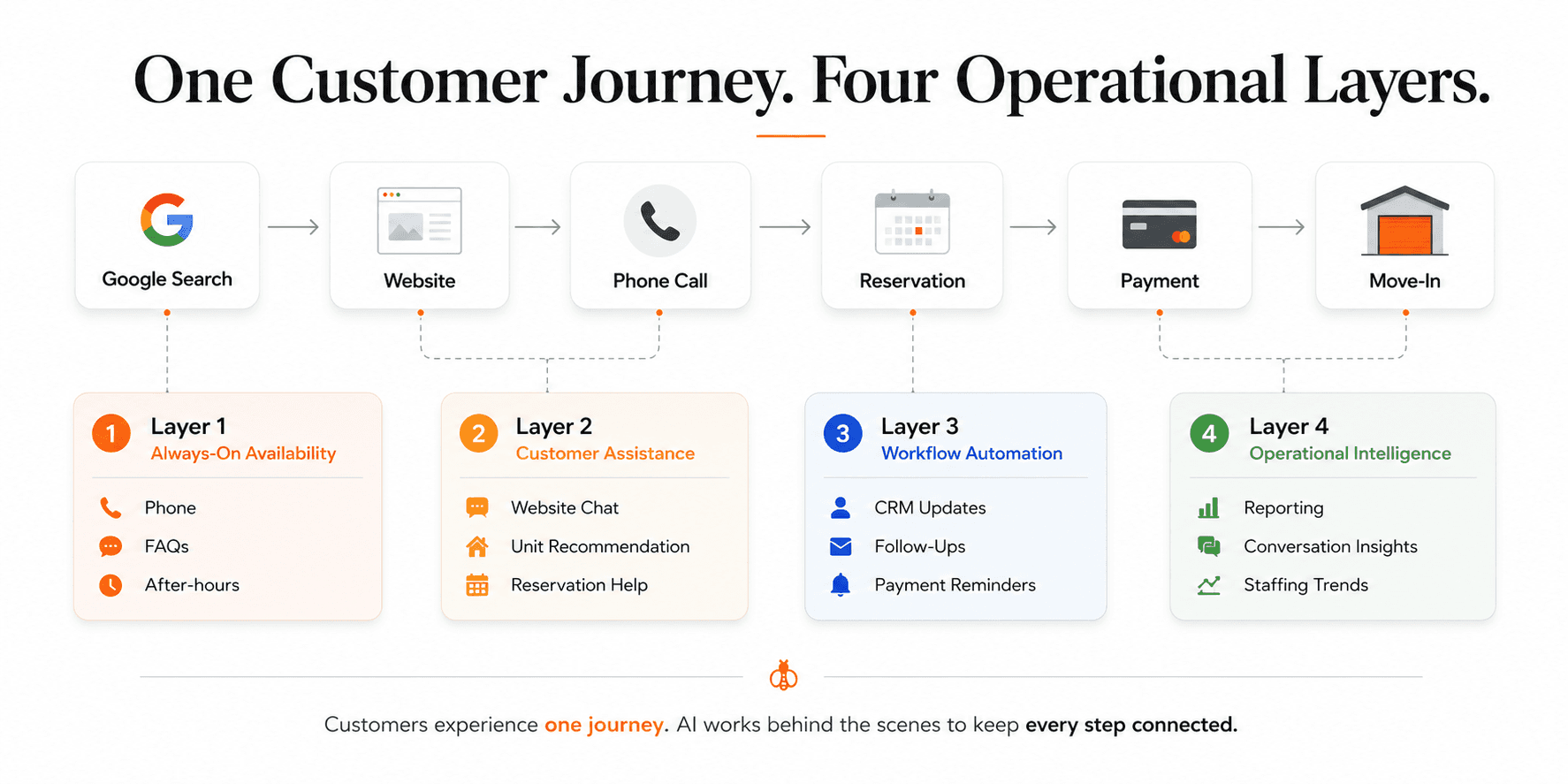
Start with Your Biggest Bottleneck
Don't begin by asking:
"Where can we use AI?"
Instead ask:
"What repetitive work is slowing our team down?"
The best AI projects don't start with technology.
They start with operational pain.
Walk through a typical day at your facility and identify the tasks that happen repeatedly:
Answering the same questions
Returning missed calls
Helping customers choose unit sizes
Processing reservations
Following up with leads
Sending payment reminders
Managing delinquent accounts
If a task happens dozens of times every week, it's a strong candidate for AI.
The Four Layers of AI Adoption
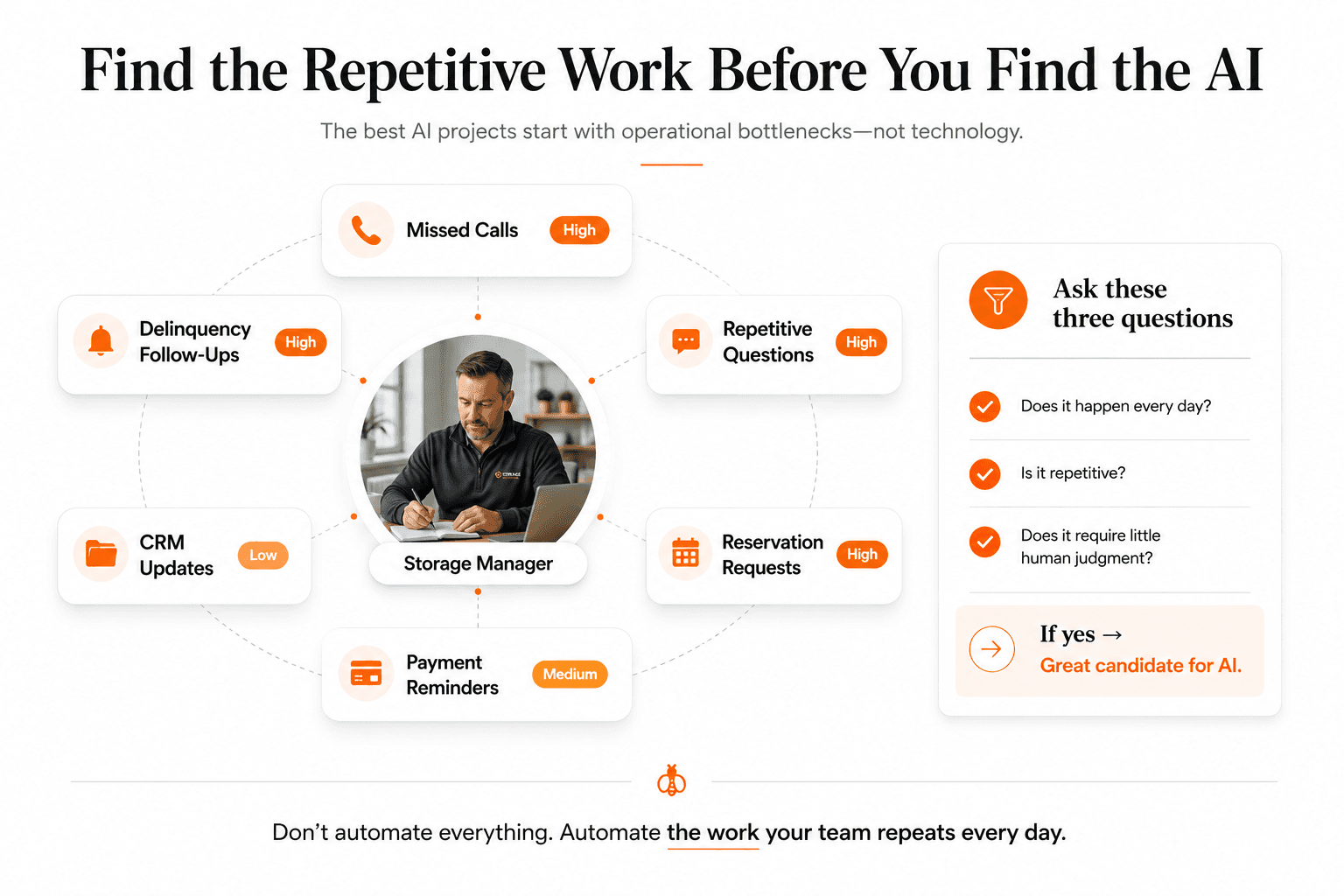
One of the biggest misconceptions about AI is that it has to transform an entire business overnight.
The strongest deployments don't.
They build capability gradually, adding one layer at a time.
(Insert "AI Maturity for Self-Storage Operators" visual here.)
Start with availability.
Then customer assistance.
Then workflow automation.
Finally, operational intelligence.
Each layer creates value while preparing the foundation for the next.
Phase 1: Never Miss a Customer
The easiest place to begin is customer communication.
Many prospective renters call outside office hours or while staff are helping someone else.
An AI voice assistant can:
Answer calls 24/7
Respond to common questions
Recommend unit sizes
Schedule reservations
Escalate complex conversations to your team
This doesn't replace your managers.
It simply ensures every customer receives an immediate response.
Phase 2: Automate Routine Work
Once customer communication is working well, look inward.
Every facility has repetitive administrative tasks that quietly consume hours every week.
Examples include:
CRM updates
Reservation confirmations
Follow-up emails
Payment reminders
Lead qualification
Internal notifications
These tasks aren't difficult.
They're simply repetitive.
Automating them gives managers more time to focus on customers and facility operations.
Phase 3: Improve Delinquency Management
One area where AI can deliver immediate operational value is delinquency management.
Following up on overdue accounts is time-consuming, repetitive, and often inconsistent when handled manually.
AI can support your existing collections process by:
Sending payment reminders before due dates
Following up through voice calls, SMS, or email
Answering common billing questions
Directing tenants to secure payment portals
Escalating unresolved accounts to your team based on predefined rules
The goal isn't to replace your collections process or make payment decisions on your behalf.
It's to ensure every tenant receives timely, consistent communication while freeing your staff to focus on situations that require empathy, negotiation, or policy decisions.
For operators managing multiple locations, that consistency can significantly reduce administrative effort and improve follow-up rates.
Phase 4: Connect Your Systems
Customers experience one journey.
Behind the scenes, your business may rely on several systems:
Facility/Property management software
CRM
Phone system
Website
Payment portal
Email platform
Without integration, your team often repeats work by manually transferring information between systems.
The strongest AI implementations connect these workflows so information moves automatically, creating a smoother experience for both customers and staff.
Common Mistakes to Avoid
Many AI projects struggle—not because the technology fails, but because the implementation starts with the wrong expectations.
Avoid these common pitfalls:
Trying to automate everything
Focus on one workflow first.
Success builds momentum.
Measuring features instead of outcomes
Don't ask:
"How many AI conversations did we have?"
Instead ask:
Did we answer more inquiries?
Did response times improve?
Did managers save time?
Did reservations increase?
Did payment reminders become more consistent?
Operational outcomes matter more than feature lists.
Ignoring Human Escalation
Not every conversation should be automated.
Customers dealing with billing disputes, security concerns, or sensitive issues should always have a clear path to a human team member.
The best AI knows when to step aside.
How to Measure Success
AI should improve business outcomes—not simply introduce new technology.
Track metrics such as:
Missed calls reduced
Average response time
Website conversion rate
Reservation completion rate
Staff hours saved
Delinquency follow-up completion
Payment collection response rates
Customer satisfaction
Occupancy growth
These metrics tell a much clearer story than the number of automated conversations.
A Practical 90-Day Roadmap
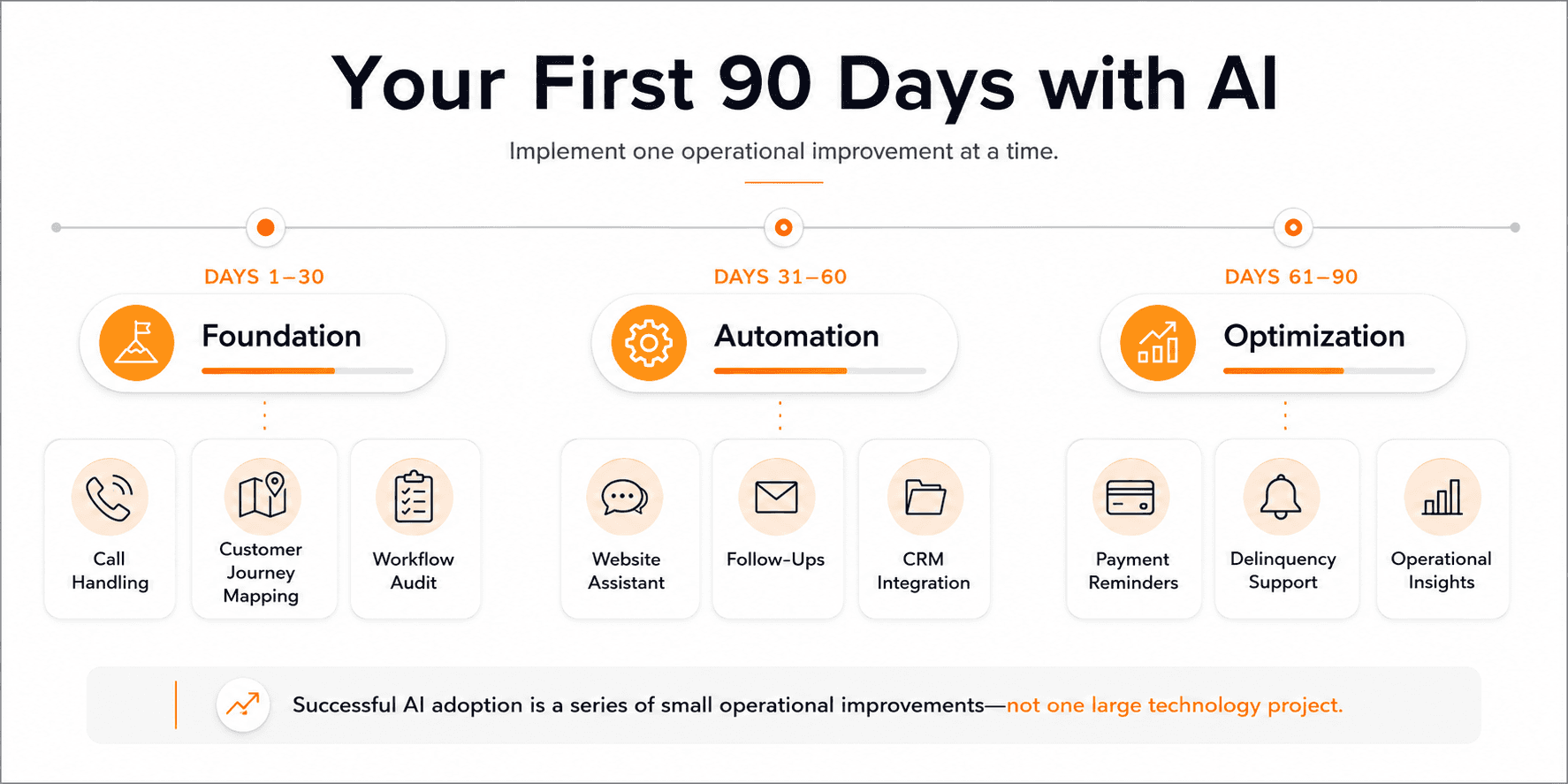
Instead of implementing everything at once, consider a phased approach.
Days 1–30
Identify repetitive workflows
Map your customer journey
Implement always-on call handling
Days 31–60
Add website assistance
Automate follow-ups
Connect CRM workflows
Days 61–90
Introduce payment reminders
Support delinquency communications
Measure operational impact
Expand to additional workflows
Small improvements made consistently often deliver more value than a large rollout that overwhelms your team.
Final Thoughts
The most successful AI implementations don't begin with ambitious technology projects.
They begin with a simple question:
"What is slowing our team down today?"
For many operators, the answer is missed calls.
For others, it's repetitive administrative work.
For growing portfolios, it may be managing customer communications across multiple locations—or ensuring delinquency follow-ups happen consistently and on time.
Wherever you begin, the principle remains the same.
Start with one operational problem.
Solve it well.
Measure the impact.
Then build from there.
The best AI implementations aren't defined by how much they automate.
They're defined by how much easier they make it for customers to rent, for tenants to get support, and for your team to focus on the work that matters most.