Self-Storage Close Rate: Why It's Low and How AI Fixes It (2026)
Most self-storage operators lose 30–50% of leads before they ever talk to a human. Here's what's killing your close rate in 2026 — and the AI fix that actually works.
Why Your Self-Storage Close Rate Is Lower Than It Should Be — And How AI Fixes It
Ask any self-storage operator what their biggest operational challenge is in 2026 and the answer usually comes back the same way: we're not converting enough of the leads we're already getting.
Not a lack of demand. Not a pricing problem. Not even a marketing problem — at least not primarily. Self-storage lead conversion is where the real gap lives. Inquiries coming in, storage facility phone calls being made, website visits happening — and somewhere between "interested prospect" and "signed tenant," a significant share of those leads are disappearing.
Average asking rent dropped 10.7% year-over-year in Q4 2025, and over 90% of institutional facilities now rely on dynamic pricing, compared to just 15–20% of independent operators. In a market where rates are soft and REITs are pricing aggressively, independent operators cannot afford to lose leads they already paid to generate. Every unconverted inquiry is doubly expensive: you paid to attract it, and your competitor got the rental.
This post explains exactly what is depressing self-storage sales conversion in 2026, what the data says about where leads are actually being lost, and how AI is solving the problem for operators right now.
What Is a "Close Rate" in Self Storage — and What Should Yours Be?
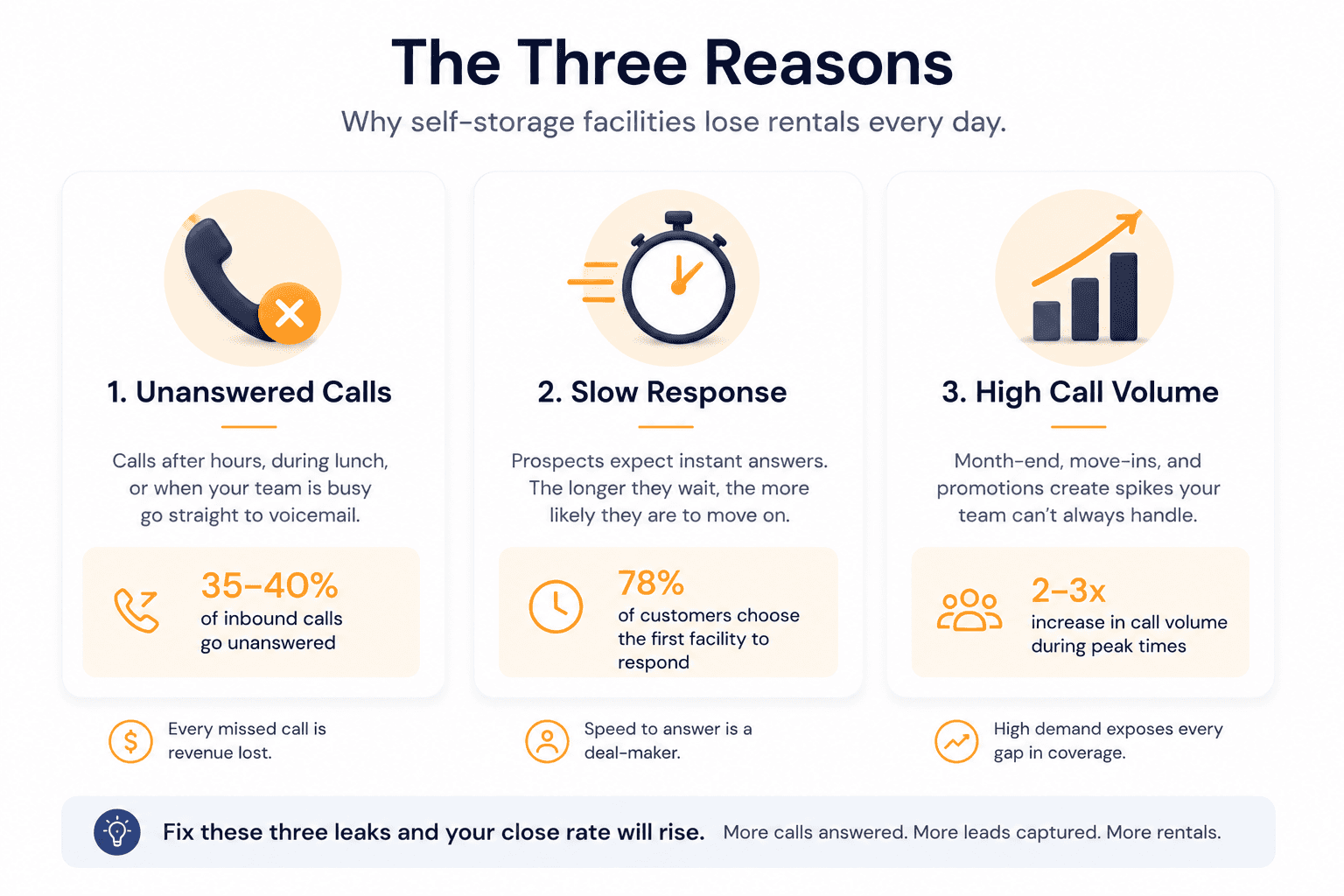
In self-storage, your close rate is the percentage of inbound inquiries — calls, web chats, walk-ins, and form submissions — that convert into a signed rental agreement or confirmed reservation. It is the final output of your entire self-storage leasing process, from first contact to keys in hand.
Industry benchmarks vary by market, operator size, and channel, but a well-run facility with good systems should be closing between 30% and 45% of inbound phone inquiries from new prospects. Operators using AI-assisted communication consistently report close rates at the higher end of that range, while facilities relying on manual staffing alone — particularly after hours — often sit significantly below it.
The gap between those two numbers, multiplied across a year of inbound volume, is the revenue difference between a thriving facility and a struggling one. Improving storage rental conversion by even five to ten percentage points, without spending a dollar more on marketing, is one of the highest-leverage moves available to an independent operator in today's market.
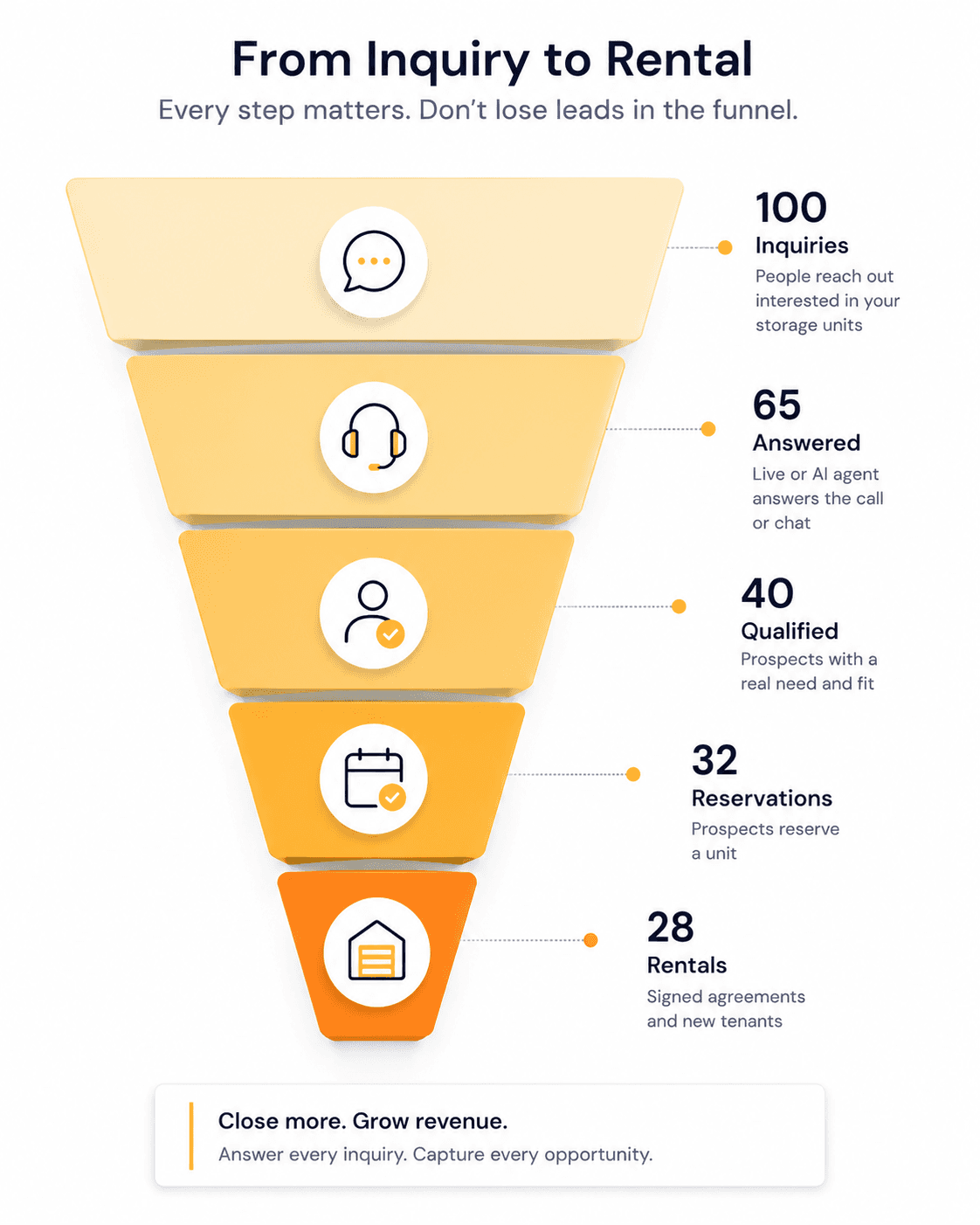
The Three Reasons Self-Storage Close Rates Are Underperforming in 2026
1. Missed Calls in Self-Storage Are More Costly Than Operators Realise
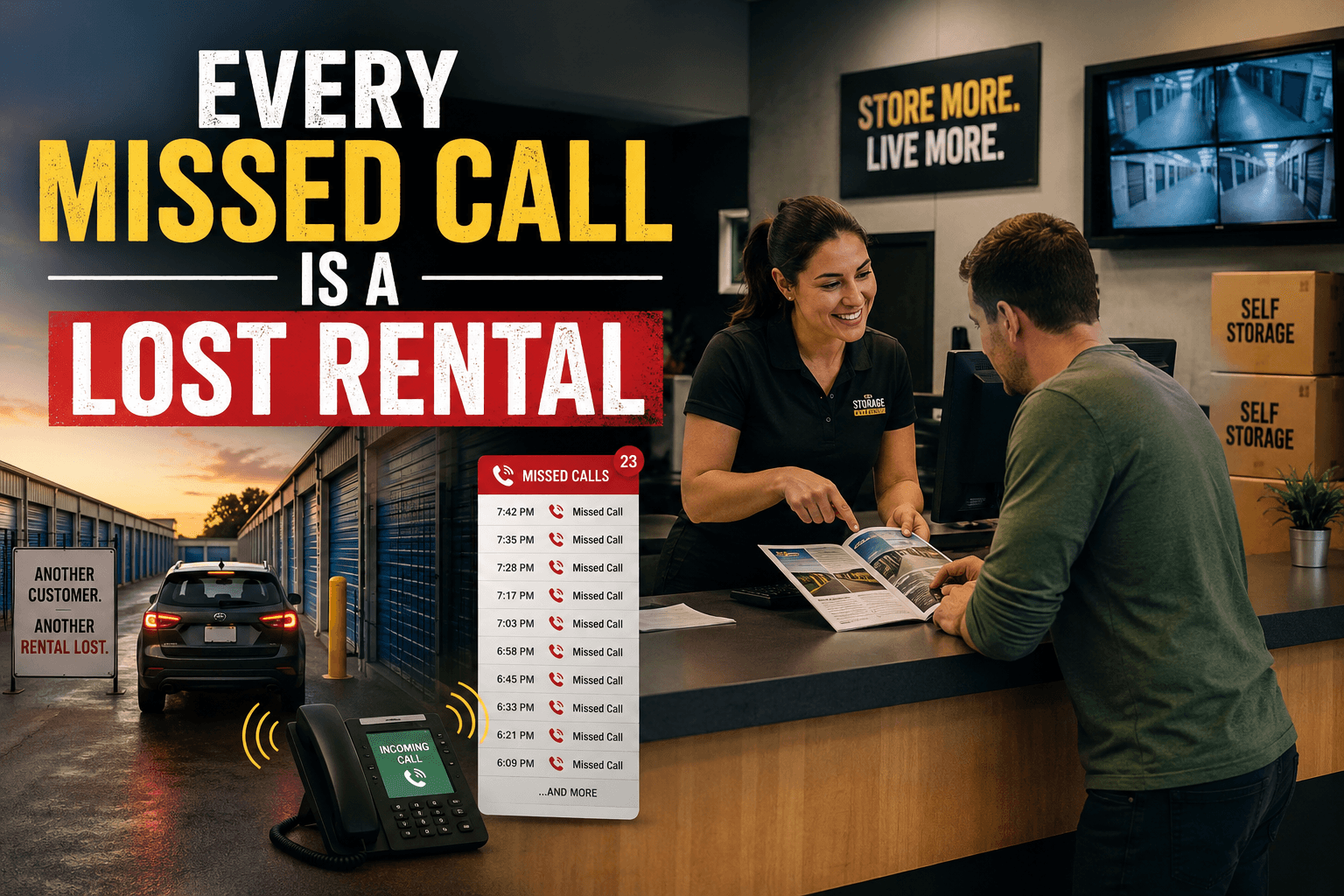
The most persistent and most costly close rate killer in self-storage is simple: the phone rings and nobody picks up.
Missed calls in self-storage are not an edge case — they are the norm. Industry data consistently puts unanswered inbound calls at 35–40% overall, with after-hours calls representing the sharpest drop-off. About 1 in 3 calls to a storage facility comes in after business hours. That is a third of inbound phone volume happening when most facilities have nobody available for after-hours call answering.
The prospect who calls at 7:30 PM on a Tuesday after realising they need storage for an upcoming move does not leave a voicemail and wait until 9 AM. 63% of customer engagement happens after business hours, according to Storable's Agent Assist deployment data. These are not low-intent browsers. They are people who have identified a need, done their research, narrowed it to your facility, and picked up the phone. Missing that call does not just mean losing a reservation — the average self-storage tenant now stays 18.5 months, which means a single missed call can represent over $2,000 in lost lifetime revenue at standard unit rates.
2. Response Speed Decides the Rental Before You Know the Lead Exists
When a prospective tenant calls asking about a unit, there are two ways the call can end: with a message taken, or a reservation made. The difference in conversion rate is nearly 2x.
Speed is not just a nice-to-have in the self-storage leasing process — it is the primary conversion variable. The operator who answers immediately, provides accurate pricing and availability, and completes the reservation in a single interaction wins the rental. The operator who calls back two hours later, or whose website chat widget shows offline, loses it.
Good storage facility customer service is no longer defined by friendliness alone — it is defined by availability. A prospect who gets an instant answer from a REIT call center and a voicemail from your facility will choose the REIT, even if your facility is the genuinely better option. REITs' advertised rents are already roughly 7.5% lower than non-REIT operators as of January 2026. Independent operators need to win on speed and service to compete — and that starts with answering every call.
3. Month-End Call Volume Overwhelms Manual Teams
Every storage operator knows what happens in the first week of the month. By the 4th and 5th, call volume runs at three times the normal rate. Staff who can handle Tuesday afternoon storage facility phone calls cannot handle the same load on the 4th of the month. Calls stack. Hold times grow. Some go unanswered entirely.
This is where a traditional self-storage call center model breaks down under load. Human agents — whether in-house or outsourced — have a fixed capacity. When volume exceeds that capacity, close rates drop. The result: the most commercially important days of the month are exactly the days your self-storage sales conversion takes its biggest hit.
What the Best-Performing Operators Are Doing Differently
The operators posting strong close rates in 2026 share a common operational characteristic: they have eliminated the gap between inquiry and response through storage facility automation.
Storable's Agent Assist, deployed across operator websites, handled over 97% of tenant requests automatically in early results, saving an average of nine staff hours per month per operator. 10 Federal Storage reported running 120 properties entirely through automation by February 2026, with AI call resolution rates jumping from 10% to nearly 80% over the same period.
Across operators using self-storage voice AI in documented deployments, the pattern is consistent: facilities that answer every call around the clock — with live data from their storage management software — capture meaningfully more of the inquiries they are already generating. Not through better marketing. Not through lower prices. Simply by being available when the prospect is ready.
For one multi-facility Indiana operator, 68% of all inbound calls were handled without human involvement. That freed the human team to focus on in-person tours, lease renewals, and the complex tenant situations that genuinely benefit from human judgment. The routine, high-volume calls — pricing, availability, gate codes, payment processing — were handled instantly by AI, at any hour, without hold times.
How AI for Self-Storage Specifically Improves Your Close Rate
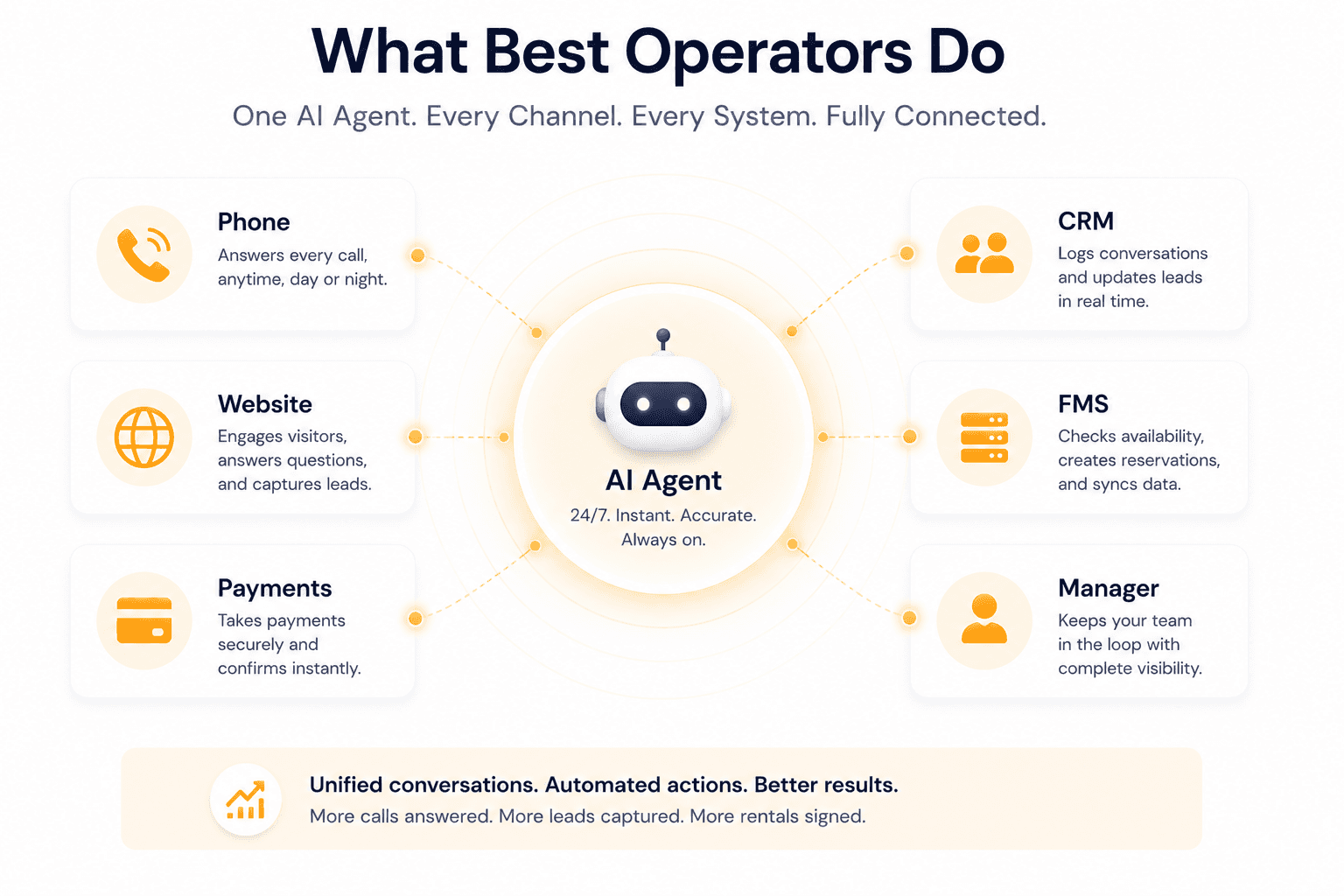
AI for self-storage improves close rates through four specific mechanisms:
Availability: Every call answered on the first ring, at every hour. After-hours call answering is fully automated — the prospect who calls at 10 PM gets the same quality of response as one who calls at 10 AM. No voicemail, no hold music, no "we'll call you back in the morning."
Accuracy: Because the AI reads live data from your storage management software integration — real-time unit availability, current pricing, active promotions — every answer is current and specific to your facility. No more "let me check on that and call you back," which is where self-storage reservations go to die.
Speed to reservation: A well-configured self-storage voice AI agent completes a full reservation — unit selection, pricing agreement, information collection, system write-back — in a single call. No callback required. No form to fill in later. The unit is off the market before the prospect hangs up, completing the self-storage leasing process end-to-end without human involvement.
Consistent escalation: When a call involves a dispute, a sensitive situation, or anything outside the AI's configured scope, it transfers to a human agent with full context already documented. This is where storage facility customer service stays at its highest quality — humans handle what humans do best, and AI handles the volume that used to overwhelm them.
What to Look for When Evaluating AI for Your Facility
Not all platforms perform the same way in production. When evaluating options for improving storage rental conversion, the questions that actually reveal capability are specific:
What is your automation rate across all call types — not just FAQs? Handling "what are your hours?" automatically is easy. Handling a payment, a gate code request with identity verification, and a new reservation all in the same platform is what separates purpose-built self-storage call center AI from generic tools.
Does your platform have two-way storage management software integration? Read-only means the AI can give information but cannot complete transactions. Write-back capability — where self-storage reservations, payments, and tenant notes flow back into your system automatically — is what makes AI genuinely replace a manual interaction rather than just delay it.
Can I hear a live call to one of your deployed customers? Not a scripted demo. A real, unannounced call to a live facility. Voice quality, response latency, and natural language handling under unusual questions only become apparent on a live call.
What does your escalation flow look like? When the AI determines a human is needed, what does that transfer look like? This is where storage facility customer service either holds together or breaks — and where many platforms fall short.
See how EasyBee AI handles all of this →
The Close Rate Math: What This Means for Your Revenue
The calculation is straightforward.
Take your current monthly inbound call volume. Multiply by your estimated missed call rate — if you do not know it, use 35–40% as the industry baseline. Multiply that by your average close rate on answered calls. Then multiply by 18.5 months of average tenant stay and your average monthly unit rate.
That number is what missed calls in self-storage are actually costing you — not per year, but compounding, every month, invisibly.
One in three Americans currently uses self-storage, with another 18% planning to rent a unit in the future. The self-storage market is projected to grow from $54 billion in 2021 to $83.6 billion by 2027. The demand is real. The leads are coming in. The operators who build the systems to convert them — through storage facility automation, self-storage voice AI, and reliable after-hours call answering — will capture a disproportionate share of that growth.
Your close rate is not a marketing problem. It is an operational problem. And it has a specific, deployable, measurable fix.
EasyBee AI deploys voice and chat AI agents purpose-built for self-storage operators — answering every call and web inquiry 24/7, with full storage management software integration, real-time pricing and availability, payment processing, and intelligent escalation to your human team when it matters.
Book a free demo and hear a live call →